
AI Automation Change Management Checklist
Use this AI automation change management checklist to plan ownership, training, rollout, feedback, safeguards, documentation, and safe rollback.
An AI automation change management checklist helps a team introduce an AI-assisted workflow without losing ownership, context, or control. Before launch, document the current process, define which decisions remain human, train the people affected, stage the rollout, collect structured feedback, and prepare a rollback path. The technology matters, but the operating change determines whether the workflow can be used safely and maintained after launch.
Why does AI automation need change management?
An AI integration changes more than a sequence of software steps. It can change who reviews work, where exceptions go, which data is visible, how long a task waits, and who is accountable for the final action. If those decisions are left implicit, a technically functional automation can still create confusion.
Change management makes the new operating model explicit. It answers practical questions:
- What problem is the workflow meant to solve?
- Which steps will change?
- Which decisions stay with people?
- Who owns normal operation and exceptions?
- How will the team know whether the rollout is working?
- What happens if the workflow needs to pause or revert?
Start with one bounded workflow rather than an abstract goal to “use AI.” A focused scope is easier to explain, test, review, and reverse. The AI workflow documentation template is a useful companion for capturing the process before implementation.
A successful rollout gives people a clear way to use, question, correct, and stop the automation.
1. Document the current workflow first
Before describing the future state, write down how the task works today. A simple current-state map should include:
- The event that starts the work
- Required inputs and where they come from
- Each decision or transformation
- Systems and accounts involved
- People who perform or approve steps
- Common exceptions and incomplete inputs
- The final action or record
- Existing measures of quality or completion
Do not clean up the current process on paper. Record the real version, including manual workarounds and handoffs. Those details often reveal hidden requirements that a high-level process diagram misses.
For example, a request-triage workflow may appear to be “read a form and assign a category.” In practice, a team member may also check whether the requester is an existing customer, remove sensitive notes, merge duplicate requests, and recognize urgent cases. Each action needs an explicit treatment in the proposed workflow.
Mark the source of truth for every important field. If an automation can read a contact name from three systems, define which system wins when they disagree. Also identify actions that are irreversible or externally visible, such as sending a message, changing access, updating billing data, or publishing content.
2. Define what changes and what stays human
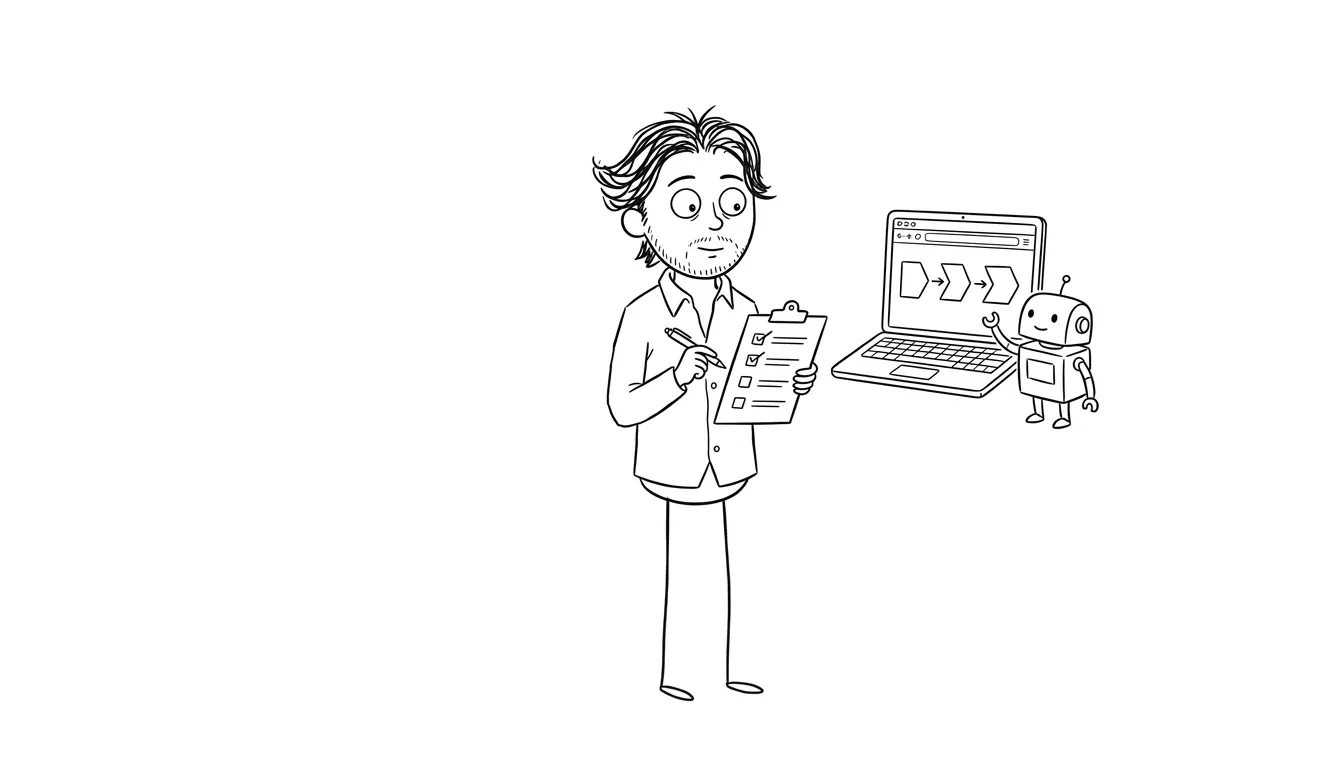
Describe the future workflow step by step. Label each step as one of four types:
- Automated: runs without routine approval within defined limits
- AI-assisted: proposes an output for a person to review
- Human-owned: requires judgment or authorization
- Escalated: moves to a named person when a rule or validation fails
This classification prevents vague promises about “human in the loop.” A real review step identifies who reviews, what evidence they receive, which criteria they use, and what actions they can take.
Separate generation from execution wherever the consequence matters. An AI system can draft a response, classification, summary, or recommendation without automatically sending or applying it. Validation and approval can sit between the proposed output and the external action.
Write down non-goals too. A first release might help summarize intake while leaving prioritization and customer communication manual. Clear non-goals reduce pressure to expand the workflow before its core behavior has been tested.
The human review checklist covers review ownership, queues, approval criteria, and stop controls in more detail.
3. Identify everyone affected by the change
List the roles that create inputs, use outputs, review exceptions, maintain systems, or answer questions about the process. For a small business, one person may hold several roles, but the responsibilities should still be named.
A stakeholder map can include:
| Role | What changes | What they need before launch |
|---|---|---|
| Requester | New form, fields, or response expectations | Clear instructions and status messages |
| Operator | Different daily steps or queue | Training, examples, and escalation rules |
| Reviewer | New approval responsibility | Source context, criteria, and review controls |
| Process owner | Accountability for results | Metrics, alerts, and authority to pause |
| Technical owner | Integration maintenance | Logs, credentials, documentation, and tests |
| Data owner | New processing or retention path | Access, minimization, and retention review |
Avoid treating “the team” as the owner. Use role names or a maintained ownership record. If the primary owner is unavailable, define backup coverage and which operations should pause.
Consider people who are affected indirectly. A new intake classifier might alter what sales sees first. A summary tool might change the context available to support. A drafting workflow might affect the tone and approval burden of customer communication. These downstream changes belong in the rollout plan.
4. Explain the workflow in plain language
A rollout brief should make sense without implementation jargon. Include:
- The specific problem being addressed
- What the automation will and will not do
- The inputs it uses
- Where its output appears
- Which outputs require review
- Known limitations and prohibited uses
- How to report an issue
- Who owns the workflow
- How to pause it
Do not market the system internally as infallible or autonomous if people still need to verify its work. Set accurate expectations: an AI-assisted result is a proposal governed by workflow rules, validation, and review.
Use examples that show both normal and exceptional cases. A normal example teaches the intended path. An exception example teaches when to stop, edit, reject, or escalate. Keep examples generic and free of real sensitive information.
The NIST AI Risk Management Framework organizes AI risk work around governing, mapping, measuring, and managing. Its supporting Generative AI Profile can help teams consider risks that extend beyond a model response itself.
5. Train people on decisions, not just buttons
Tool training often focuses on where to click. AI workflow training should also cover how to judge the output.
Build a short training set with representative examples:
- A valid input and acceptable result
- An incomplete or ambiguous input
- A result with the right format but unsupported content
- Sensitive data that should not be processed or exposed
- A high-impact case that requires approval
- An integration failure or unavailable source
- A result that should be rejected and escalated
For each example, show the expected action and why. Reviewers should know how to approve, edit, reject, and escalate. They should also know whether edits are captured as feedback, whether the original output is retained, and which information belongs in an incident or support report.
Training materials should match the live workflow version. Store them with the standard operating procedure, ownership details, and change history rather than in a temporary launch message.
The AI automation SOP checklist provides a structure for documenting normal operation, exceptions, maintenance, and recovery.
6. Roll out in stages with explicit gates
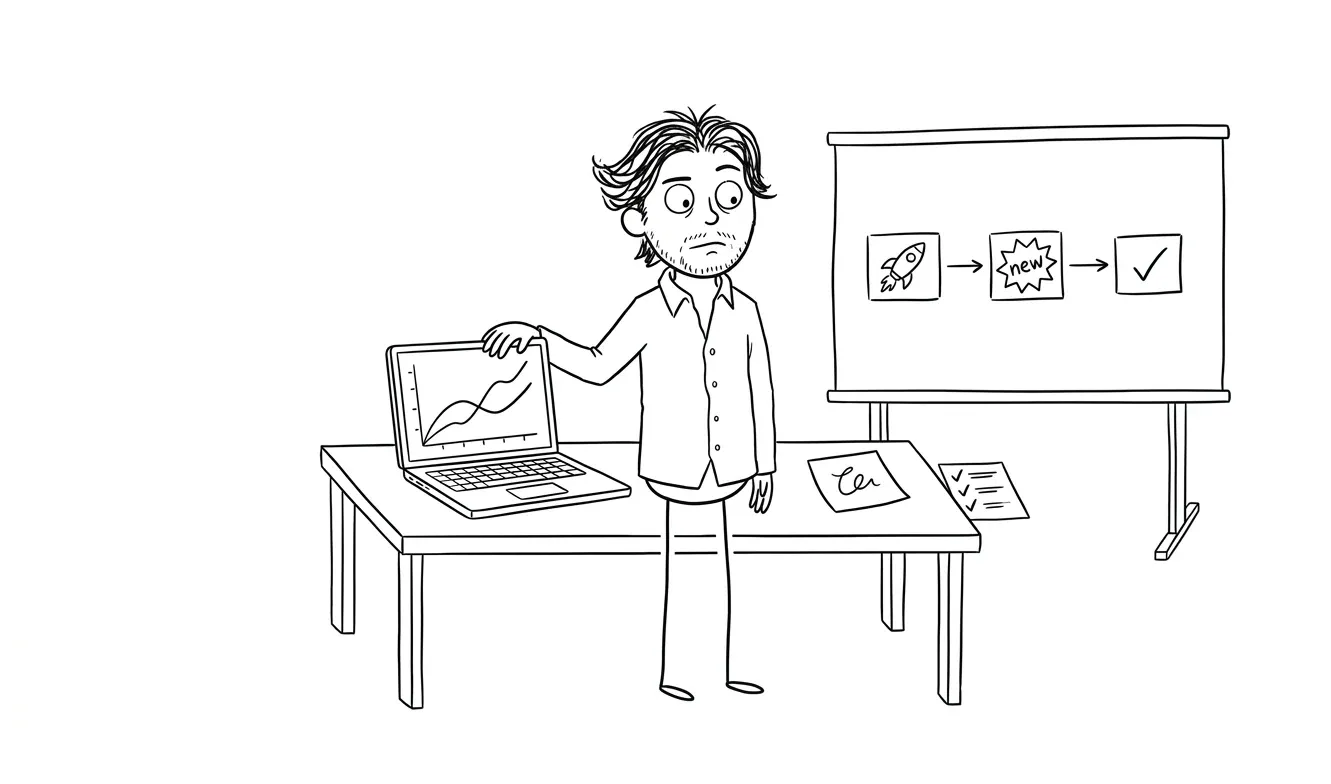
A staged rollout limits the impact of defects and gives the team time to refine instructions and controls. A practical sequence is:
- Offline evaluation: Test saved examples without affecting live work.
- Shadow mode: Run the new workflow alongside the existing process without taking action.
- Limited pilot: Use it for a narrow input type, internal group, or low-impact task.
- Reviewed production: Process live work with mandatory approval.
- Conditional automation: Allow only validated, low-risk cases to proceed automatically.
- Broader rollout: Expand scope after the defined gates pass.
Each stage needs entry and exit criteria. Useful gates can include:
- Required test cases pass
- Reviewers can identify known failure types
- Exceptions reach the correct owner
- Logs contain enough context to investigate
- Duplicate or irreversible actions are prevented
- Access and retention controls are confirmed
- Rollback has been rehearsed
- Documentation reflects the live behavior
Avoid advancing a rollout because a calendar date arrived. Advance when the workflow meets its agreed criteria and the responsible owner approves the next stage.
7. Collect feedback that can drive a decision
“Does this work?” produces vague answers. Give operators and reviewers structured feedback options tied to the workflow:
- Input was incomplete
- Source data was wrong or unavailable
- Output format was invalid
- Result was unsupported by the source
- Suggested action violated a business rule
- Review context was missing
- Escalation went to the wrong place
- The workflow added unnecessary effort
- The result was useful without changes
Capture the workflow version, input category, outcome, and reviewer action with each feedback item. Do not collect sensitive source data again if a secure reference is enough.
Assign a review cadence and an owner for deciding what feedback changes. Some feedback indicates a prompt adjustment; some points to missing source data, unclear policy, poor interface design, or an unsuitable use case. Treating every issue as a prompt problem can hide the actual process failure.
Share resolved decisions back with users. A feedback channel loses value when people cannot see whether reports were understood, declined, or fixed.
8. Update access, documentation, and support
A workflow is not ready when only its builder knows how it works. Before launch, verify:
- Production accounts have named owners
- Permissions follow least privilege
- Credentials are stored and rotated appropriately
- Joiner, mover, and leaver procedures cover the workflow
- Support requests have a monitored destination
- Alerts identify the job and next action without exposing secrets
- The SOP links to current diagrams and tests
- Model, prompt, schema, and integration versions are recorded
- Vendor and data-handling decisions are documented
- A backup owner can perform essential recovery steps
Update adjacent documentation too. If a form changes, revise its instructions. If a queue becomes the new source of truth, remove conflicting process notes. If response expectations change, update any customer-facing language that refers to the old process.
The AI automation permissions checklist helps define account ownership, scopes, offboarding, and access reviews.
9. Define pause, rollback, and recovery criteria
Change management needs a safe way back. Define conditions that pause automation before launch, such as:
- Validation rules stop functioning
- Sensitive data reaches an unauthorized destination
- An external action is duplicated
- Review queues have no available owner
- Source data becomes unavailable or unreliable
- A model or integration changes without evaluation
- Results fall outside agreed business rules
A pause should preserve the original task and its status. Decide whether work returns to the previous manual process, enters a review queue, or waits for recovery. Communicate degraded behavior honestly to affected users.
Rollback documentation should identify the control used to stop new runs, how in-progress items are handled, how completed actions are reconciled, and who authorizes restoration. Test those steps before they are needed. The AI automation rollback checklist provides a more detailed recovery framework.
AI automation change management checklist
Use this condensed checklist during planning and rollout.
Current and future state
- The current workflow is documented as it actually operates
- Inputs, systems, decisions, exceptions, and outputs are mapped
- Irreversible and externally visible actions are identified
- Automated, AI-assisted, human-owned, and escalated steps are labeled
- The first release has clear goals and non-goals
Ownership and communication
- Every affected role is identified
- Operational, technical, review, and data owners are named
- Backup coverage and pause authority are defined
- The rollout brief explains capabilities and limits plainly
- Users know where to report problems
Training and rollout
- Training includes normal, ambiguous, unsafe, and failed cases
- Reviewers can approve, edit, reject, and escalate
- Rollout stages have measurable entry and exit gates
- Offline, shadow, pilot, and reviewed-production stages are considered
- The process owner approves each expansion of scope
Feedback and operations
- Feedback categories map to actionable workflow problems
- Feedback records the relevant workflow version and outcome
- A named owner reviews and resolves feedback
- Access, credentials, retention, support, and offboarding are documented
- SOPs and training materials match the production version
Safety and recovery
- Pause conditions are explicit
- In-progress work has a safe state during interruption
- The previous manual path or degraded mode is documented
- Rollback and reconciliation steps are tested
- Restoration requires owner approval and verification
How should a small business scope this work?
Choose one workflow with a clear trigger, defined output, available owner, and manageable consequence if the system pauses. Document the current path, then identify the narrowest AI-assisted step that can be tested without handing over an irreversible decision.
A focused Audit + Spec is $500 and examines one lens at a time, such as rollout readiness for a specific workflow. The fee is credited 100% toward follow-on work booked within 30 days. Dee Agency’s AI Integration & Automation service is $3,000 for a focused implementation. The services overview explains the available paths.
Frequently asked questions
What is change management for AI automation?
It is the process of defining how an AI-assisted workflow changes roles, decisions, training, documentation, support, feedback, and recovery. It gives the people affected a clear operating model rather than treating deployment as only a technical release.
Who should own an AI automation rollout?
Name a process owner accountable for the business workflow and a technical owner responsible for the integration. Also identify reviewers, data owners, and backup coverage. One person may fill several roles, but each responsibility should be explicit.
Should AI automation start with a pilot?
A limited pilot is usually a safer step than immediate broad deployment. Test saved examples first, consider shadow mode, then introduce a narrow live scope with mandatory review and defined exit criteria.
What should employees learn before using an AI workflow?
They should understand the workflow’s purpose, permitted inputs, limits, review criteria, exception path, feedback method, and stop procedure. Training should include flawed and ambiguous examples, not only the happy path.
When should an AI workflow be rolled back?
Use predefined pause or rollback conditions tied to meaningful risk: failed validation, unauthorized data exposure, duplicate actions, unavailable ownership, unreliable sources, or untested system changes. Preserve in-progress work and verify the manual or degraded path before restoring service.
Make the operating change part of the build
AI automation change management turns a technical workflow into an owned business process. Map the current state, define human decisions, train with realistic cases, stage the rollout, collect useful feedback, and test the way back before expanding scope.
Dee Agency’s AI Integration & Automation service is $3,000 for a focused implementation. If rollout readiness needs diagnosis first, the $500 Audit + Spec can examine one focused lens, with the fee credited fully toward follow-on work booked within 30 days. Share the workflow details to define the safest next step.

Got a project worth shipping? Send the brief.
Quote and kickoff date back in a day, usually faster. If it's not a good fit I'll say so.