

Focused Audit Scope Template (Before You Book)
Define your problem, pick your lens, and set expected output before booking a diagnostic. A focused audit scope template that prevents vague reviews.
A focused audit scope template helps you define exactly one problem, one lens, and one deliverable before booking a diagnostic. The dee.agency Audit + Spec is $500 and works best when you walk in knowing what you want examined. This template covers how to pick your lens (UX, conversion, AI automation, or AI visibility), what information to gather before you start, and what a good output looks like. Use it to avoid vague audits that produce vague recommendations.
What a focused audit scope template actually does
Most audits fail before they start. Someone books a “design review,” the reviewer looks at everything and nothing in particular, and the output is a long list of observations that don’t map to any real decision.
A scope template fixes that by forcing you to answer three questions upfront: What problem are you actually trying to solve? What’s the one lens you’re using to examine it? And what decision will this audit help you make?
That’s it. Three questions. But most teams skip them entirely.
The Audit + Spec is deliberately narrow. One lens per engagement. $500. The output is a concrete spec you can act on, not a 40-page report you’ll read once and file away. The template below shows how to scope that work before you book anything.
The four lenses: which one applies to you?
Before you fill in any template, you need to pick a lens. Here are the four I work with.
UX and product friction
Use this when: users are dropping off, support tickets mention confusion, or your team disagrees on what to fix.
The question you’re trying to answer: Where is the product creating unnecessary friction for users, and which friction points matter most?
This lens looks at flows, navigation, information hierarchy, error states, and onboarding. It doesn’t cover brand, copy strategy, or business model. If you need everything reviewed, you don’t need an audit, you need a redesign. The article UX audit vs full redesign covers exactly how to tell the difference.
Conversion and landing page performance
Use this when: traffic is coming in but conversion rate is low, you’re about to run paid ads, or you recently updated your page and want to check it before spending money.
The question you’re trying to answer: What’s stopping visitors from taking action?
This lens covers headline clarity, social proof placement, CTA friction, page structure, and trust signals. It does not cover SEO, traffic sources, or backend tracking setup.
Good conversion audits are grounded in what visitors actually do, not what you think they do. If you have heatmap or scroll data from a tool like Microsoft Clarity (free), bring it. It changes what an auditor focuses on immediately.
AI automation opportunity
Use this when: your team is doing repetitive manual work, you’re curious whether AI could save time on a specific workflow, or you’ve tried a tool and aren’t sure it’s the right fit.
The question you’re trying to answer: Which one workflow is the most practical candidate for AI automation right now?
This lens maps your current workflow, identifies the bottleneck, and evaluates feasibility. It doesn’t build anything. The AI automation audit article goes deeper on what to check before committing to a build.
AI visibility and answer-engine presence
Use this when: your service business or startup isn’t showing up when people ask ChatGPT or Perplexity about your category, or you want to know why AI tools don’t seem to know you exist.
The question you’re trying to answer: What’s blocking AI answer engines from understanding and citing your business?
This lens checks entity clarity, crawlability, schema, llms.txt, and content structure. It doesn’t cover traditional SEO rankings or paid search. The AI visibility audit checklist is a good companion read if you want to understand the full scope of what gets checked.
Picking the wrong lens is the most common scoping mistake. A company thinks they have a UX problem, but what they actually have is a positioning problem. A team thinks they need AI automation, but the real issue is that the workflow isn’t documented well enough to automate. Spend five minutes on lens selection before anything else.
The focused audit scope template
Copy this. Fill it in. Bring it to any diagnostic conversation, whether with me or anyone else.
Focused audit scope template
1. The problem in one sentence What is going wrong, specifically? Avoid “we need to improve conversion” and write something like “visitors from our Google Ads campaign are landing on the pricing page and leaving without clicking through to the signup form.”
2. The lens Choose one: UX friction / Conversion / AI automation / AI visibility
3. The scope boundary What is included? List the specific pages, flows, or workflows. What is excluded? Everything else.
4. The decision this audit enables What will you do differently based on the output? If you can’t answer this, the audit scope is too vague.
5. What you already know What have you tried? What data do you have? What hypotheses do you have about the root cause?
6. What a good output looks like Do you need a written spec? A prioritized list of fixes? A recommendation on whether to build or not? Define it upfront.
7. Timeline and constraints When do you need the output? Are there technical constraints or team dependencies the auditor needs to know about?
This is short. That’s intentional. A one-page scope document does more useful work than a ten-page brief. The goal is clarity, not comprehensiveness.
How to use this focused audit scope template before booking
Work through each field before you have any scoping conversation. Here’s how.
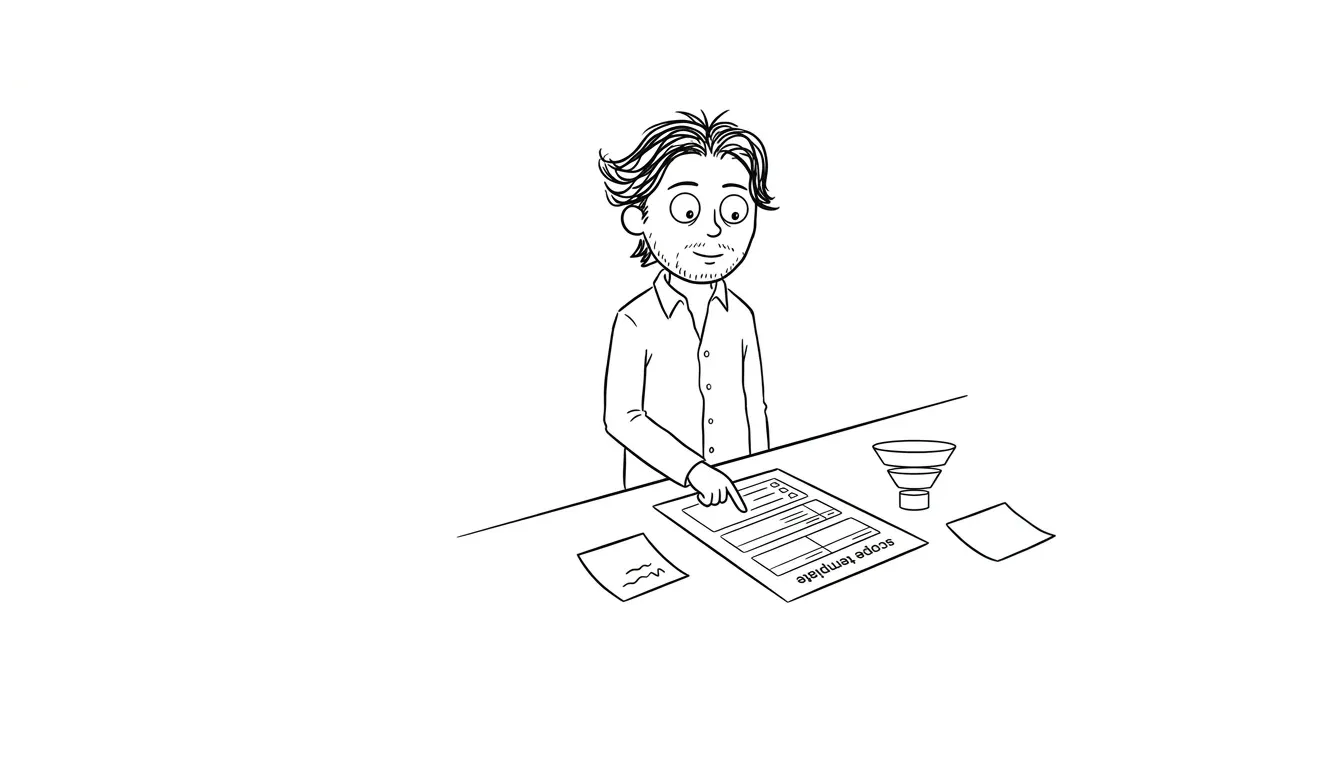
Start with field 4. If you can’t name the decision the audit enables, don’t book anything yet. Go back and figure out what you’re actually trying to decide. This is the fastest way to tell whether you need an audit or just a working session with your team.
Fill in field 1 without jargon. Write the problem the way you’d describe it to someone who doesn’t know your business. Vague language in the problem statement produces vague recommendations in the output.
Be ruthless with field 3. Every audit has a tendency to expand. If you list six pages in the scope boundary, expect the output to cover six pages. If you list one specific flow, you’ll get one specific set of actionable recommendations. Narrow is better.
Field 5 is genuinely useful. Telling an auditor what you’ve already tried saves time and avoids redundant recommendations. If you ran an A/B test on the CTA last month and it made no difference, that’s data. Include it.
Field 6 prevents output disappointment. Some founders want a list of prioritized fixes. Others want a written spec they can hand to a developer. Others want a simple yes/no on whether to rebuild or patch. These are different outputs. Say what you need.
Ready to book a focused audit? The Audit + Spec at dee.agency is $500, covers one lens, and the fee applies toward any follow-on project within 30 days. Tell Dee Agency what you’re trying to solve.
What happens after you fill in the template
Once you’ve scoped it correctly, the audit itself goes faster and the output is more useful.
For a UX friction audit, the review looks at actual flows, not hypothetical ones. That means the auditor needs access to the live product, or at minimum a working prototype. Screenshots don’t cut it for navigation and state problems.
For a conversion audit, the review needs the live page and any analytics data you have. Even rough numbers help. It also helps to know who the audience is and what action you want them to take. This maps directly to the landing page conversion audit checklist framework.
For an AI automation audit, bring a plain-language description of the workflow: what triggers it, what steps are involved, who does each step, and how long it takes. The messier this description is, the more likely the workflow isn’t ready to automate yet.
For an AI visibility audit, bring your domain, your primary service or category, the geographic market if relevant, and the queries you expect customers to use when asking AI tools about your type of service. Then the review checks what’s actually blocking visibility.
The Spec output from any of these audits is a written document that either defines what to build (if the follow-on work is a build) or defines what to fix (if the work is a targeted repair). It’s not a report for its own sake. It’s a decision document.
How to tell if your scope is tight enough
Filling in the template is step one. Checking that it’s actually tight enough is step two.
Here are four quick tests.
The “so what” test. Read your problem statement and ask: so what? If the answer is “we’d know whether to redesign the onboarding flow,” you have a real decision. If the answer is “we’d have more information,” you don’t have a decision yet.
The one-page test. If your scope document is longer than one page, it’s not focused. You’ve probably listed too many included items in field 3, or you’re trying to answer more than one question. Cut until it fits.
The hand-off test. Could you hand this document to a competent auditor you’ve never spoken to, and would they know exactly what to look at? If they’d need a 30-minute call to understand the scope, the scope isn’t clear enough.
The exclusion test. Read your exclusion list in field 3. Does it feel like you’re leaving important things out? Good. That feeling is correct. An audit that tries to cover everything is just a general review with a different name. The things you’re excluding can always be scoped in a follow-on engagement.
If your scope passes all four tests, you’re ready. If it fails any of them, spend another ten minutes on the template before booking anything.
When a focused audit scope template isn’t what you need
This template assumes you know roughly which area of the product or business you want examined. Sometimes you don’t.
If you genuinely have no idea where the problem is, that’s a different kind of conversation. It might mean starting with a services overview call to figure out which lens applies, or it might mean the problem is upstream of anything an audit can diagnose.
If the scope you write out covers four different lenses, you don’t have one focused audit. You have four. Either pick the highest-priority one, or consider whether a broader engagement like an MVP build or a full landing page redesign is actually what the situation calls for.
The $500 Audit + Spec is calibrated for one specific problem. If the problem is “everything feels wrong,” that’s not a scope, that’s a starting point for a different conversation.
Common scoping mistakes to avoid
Mixing lenses. Conversion and UX are related but different. An audit that tries to cover both usually covers neither well.
Scoping the whole product. Pick the one flow or one page that matters most right now. You can always do another audit later.
Skipping the decision field. If the audit doesn’t enable a specific decision, it’s not a focused audit. It’s a research exercise.
Asking for validation instead of diagnosis. If you go in hoping the audit confirms what you already believe, you’ll either get what you want (useless) or be disappointed (frustrating). A good audit is honest about what the evidence says.
Not sharing existing data. Analytics, heatmaps, session recordings, support ticket themes. Share whatever you have. It changes what an auditor focuses on.
Treating the template as a formality. The scope document isn’t paperwork. It’s the thing that makes the audit useful. Teams that fill it in carefully get dramatically more actionable output than teams that write two sentences and move on.
How focused audits fit into a broader product workflow
A focused audit is a diagnostic, not a solution. It tells you what to fix and how to prioritize. The follow-on work is where the fix actually happens.
For UX and conversion audits, the natural next step is usually a targeted repair or, in some cases, a fuller redesign. The do you need a focused audit before a redesign article explains when one leads to the other.
For AI automation audits, the next step is typically scoping a build. If the workflow is a good automation candidate, the Spec gives you enough to brief a developer or kick off an AI integration project.
For AI visibility audits, the next step is usually a combination of content fixes, schema updates, and structural changes to key service pages. The GEO Fix service covers exactly that work.
The point is that a $500 audit de-risks whatever comes next. You’re not guessing about what to build or fix. You have a spec that tells you specifically what the problem is and what to do about it.
This is also why the fee is credited toward follow-on work within 30 days. The audit and the build are meant to be connected. You scope it, then you ship it.
For founders who want a reference on what good diagnostic frameworks look like more broadly, the Nielsen Norman Group’s guidance on UX research methods is worth reading. It covers when expert reviews (which is essentially what a focused audit is) are appropriate versus when you need actual user research. The short answer: expert reviews work well when you already have a hypothesis about where the friction is and you need it validated or refined quickly.
Similarly, for AI visibility work specifically, Google’s documentation on how Search works is a useful grounding read, even though the audit focuses on AI answer engines rather than traditional search. Many of the underlying signals, crawlability, structured content, entity clarity, overlap significantly.
Frequently asked questions
What is a focused audit scope template?
A focused audit scope template is a short document that defines one problem, one lens (UX, conversion, AI automation, or AI visibility), and one expected output before a diagnostic engagement begins. It prevents scope creep and ensures the audit produces actionable recommendations rather than generic observations.
How much does a focused Audit + Spec cost at dee. agency?
The Audit + Spec at dee.agency is $500 and covers one focused lens. The fee is credited 100% toward any follow-on project if that project is booked within 30 days.
How do I choose the right audit lens?
Start with the decision you need to make. If you need to know why users drop off, use a UX friction lens. If you need to know why visitors don’t convert, use a conversion lens. If you’re evaluating whether a workflow is automatable, use an AI automation lens. If your business isn’t showing up in AI answers, use an AI visibility lens. Pick one.
Can one audit cover multiple lenses?
The dee.agency Audit + Spec is designed for one lens at a time. Trying to cover UX, conversion, and AI visibility in a single $500 engagement produces shallow coverage across all three. Book separate audits for separate questions, or discuss whether a larger follow-on project is more appropriate.
What does the Spec output actually look like?
The Spec is a written document, not a slide deck or a report. For a build-oriented audit, it defines what to build and how. For a repair-oriented audit, it prioritizes what to fix and why. It’s written so a designer, developer, or founder can act on it without a follow-up meeting.
Do I need to prepare anything before booking a focused audit?
Fill in the scope template above before any scoping conversation. At minimum, have a one-sentence problem statement, a lens selected, and a clear answer to what decision the audit will enable. The more specific you are upfront, the faster and more useful the output will be.
Ready to scope your audit?
If you’ve filled in the template and know which lens applies, the next step is simple. The Audit + Spec is $500, takes one focused lens, and produces a written spec you can act on. If you book follow-on work within 30 days, the $500 comes off the project price.
Share what you’re trying to solve and Dee Agency can help you decide whether a focused audit is the right starting point.

Got a project worth shipping? Send the brief.
Quote and kickoff date back in a day, usually faster. If it's not a good fit I'll say so.