
How Much Does a UX Audit Cost?
UX audit costs range from $500 to $15,000. Learn what drives price, what you get, and when a focused $500 audit is enough.
A UX audit cost typically ranges from $500 to $15,000 depending on scope, who does it, and what you get at the end. A focused single-lens audit from a solo practitioner starts around $500. A full agency audit with multiple stakeholders, workshops, and a lengthy report can run $5,000 to $15,000 or more. At dee.agency, the Audit + Spec is $500 and covers one focused lens: UX friction, conversion, AI opportunity, or visibility. That’s the fastest, most affordable way to find what’s actually hurting your product.
What affects how much a UX audit costs
Price is almost entirely a function of scope and who’s doing the work. Those two factors together explain the $500 to $15,000 spread.
Scope means how many pages or flows get reviewed, how many lenses (UX, copy, conversion, accessibility, performance), and how deep the deliverable goes. A five-page landing page is not the same as a 40-screen SaaS product.
Who does it matters just as much. Agencies have overhead. They bill for account managers, project coordinators, and internal review cycles. A solo practitioner cuts all of that out and passes the savings to you without cutting the actual thinking.
Here’s how pricing generally breaks down by provider type:
| Provider type | Typical price range | Deliverable |
|---|---|---|
| Solo freelancer | $300 to $2,000 | Loom walkthrough, annotated PDF, or doc |
| Solo studio (like dee.agency) | $500 to $2,500 | Scoped report, spec, actionable fixes |
| Mid-size agency | $3,000 to $8,000 | Full audit report, workshops, presentation |
| Enterprise agency | $8,000 to $15,000+ | Multi-stakeholder engagement, roadmap |
The deliverable format matters too. A 60-slide PDF you’ll never read again is not more valuable than a focused three-page spec with prioritized fixes. Longer doesn’t mean better.
How much does a UX audit cost for a startup or early-stage product?
For founders and small teams, the math on a $10,000 audit rarely works out. You don’t need 40 pages of findings. You need to know the three things that are killing conversion and what to do about them first.
That’s the case for scoped, focused audits. At $500, the Audit + Spec at dee.agency is priced so it’s a no-brainer decision. You pick one lens, I go deep on it, and you get a clear spec. If you move forward with design or development work within 30 days, the $500 is credited toward that project.
That said, even at the low end of the market, there’s a floor. Below $200 or $300, you’re probably getting a templated checklist with generic feedback. That’s not an audit, that’s a form.
A good audit doesn’t just list problems. It tells you which ones to fix first and roughly what fixing them involves.
What a UX audit actually includes (and what it doesn’t)
There’s no industry standard for what a “UX audit” is, which is part of why prices are all over the place. Before you hire anyone, ask what’s in scope.
What should be included
- Review of actual user flows, not just a homepage screenshot
- Specific friction points with clear explanations of why they matter
- Prioritized recommendations (not a flat list of 50 issues)
- At least a rough sense of effort for each fix
What’s often bloated
- Heuristic checklists that could apply to any product (they’re usually filler)
- Competitor analysis that takes two days and doesn’t change what you should do
- User interviews billed into the audit when you already have the data
- Presentation decks that restate the report in slide form
Some of this is useful in the right context, but for early-stage founders, extra process rarely adds proportional value. The goal is clarity, not billable hours.
How heuristic frameworks fit in
You’ll hear a lot about heuristics in UX audit contexts. Nielsen Norman Group’s 10 usability heuristics are the most commonly cited framework, and they’re genuinely useful as a thinking tool. The problem is when an auditor runs your product through them mechanically and hands you a checklist without any product-specific judgment.
Heuristics surface potential issues. A good auditor interprets them in the context of your actual users, your specific flows, and your business goals. The framework is a starting point, not the deliverable.
One lens or full audit: which do you actually need?
The word “audit” implies a complete review, but that’s not always what you need.
If your conversion is tanking, you don’t need an accessibility review and a content audit. You need someone to look hard at your conversion flow. If users are dropping off during onboarding, the priority is that specific flow, not a comprehensive design system review.
That’s the logic behind the Audit + Spec: pick the lens that matches your most urgent question.
- UX friction, Where are users getting stuck, confused, or bailing?
- Conversion, Why isn’t this page or flow turning visitors into customers?
- AI opportunity, Where could automation or AI features save your users real time?
- Visibility, Is your product structured in a way that search and AI tools can understand and cite?
Each of those is its own audit. You don’t need all four. You need the one that answers the thing keeping you up at night.
If you’re not sure which lens to use, the article on what a UX audit is and when your product actually needs one covers the decision in more detail.
What you get from a $500 audit vs a $5,000 audit
Founders sometimes assume that spending more guarantees better insights. That’s not always true.
A $5,000 agency audit often includes:
- Multiple discovery calls and stakeholder interviews
- A multi-week timeline
- A polished slide deck
- Findings organized by severity and theme
- A follow-up presentation meeting
A well-executed $500 focused audit includes:
- A single, specific scope agreed upfront
- A practical written report or walkthrough
- Prioritized fixes you can actually act on
- A spec ready to hand to a designer or developer
The difference isn’t necessarily insight quality. It’s process weight. Agencies have overhead they need to justify. A solo practitioner working async doesn’t. That structure suits founders who want answers fast and don’t need a ceremony around it.
If your budget is under $2,000, a focused single-lens audit will get you more actionable value than a stretched multi-lens review that covers everything at shallow depth.
When a more expensive audit is worth it
There are real cases where paying more makes sense.
If you’re running a product with dozens of distinct user flows, different permission levels, multiple device targets, and a large enough team that you need a presentation to align stakeholders, then yes, a $5,000 to $8,000 agency engagement might be justified.
If you’re a Series B company trying to diagnose retention problems at scale, you might want user research integrated with the audit, which adds real cost.
If you need the audit to serve as documentation for investors or an external board, the polished agency format matters.
But for most founders reading this, none of those apply. You have a product that isn’t converting the way you hoped, or onboarding that’s losing people, or a landing page that gets traffic but no signups. That problem doesn’t need a $10,000 solution.
What to watch out for when hiring for a UX audit
There are a few patterns worth knowing before you start conversations.
Audits priced by deliverable length. If a freelancer quotes you based on “I’ll give you a 50-page report,” ask what’s in those 50 pages. Length is not a proxy for value.
No upfront scope agreement. If the scope isn’t clear before you pay, the deliverable will be vague too. Get specifics: what flows are covered, what the format is, what the turnaround is.
Generic heuristic checklists. Some providers use a standard framework as a template and run your product through it mechanically. That can produce decent findings, but it also tends to produce findings that apply to every product, not your specific problem.
Audits without prioritization. A list of 30 issues without any signal about which three to fix first is not useful. Prioritization is part of the work.
No path forward. An audit should leave you with a clear idea of what to do next. If the report ends with “these are the problems,” and you still don’t know where to start, something’s missing.
How to get more from your audit, regardless of who does it
The quality of an audit isn’t entirely on the auditor. How you prepare matters too.
Share real data if you have it. Analytics screenshots, session recordings, support tickets, or even a quick list of the questions customers ask most often. Any of this gives the auditor signal that speeds up the process and improves the findings. Hotjar and similar tools are worth setting up before an audit if you don’t have session data yet.
Be specific about what you want answered. “Make my product better” is a brief that produces generic results. “Why are users completing signup but not finishing onboarding” is a question that produces useful ones. The more specific your question, the more useful the audit.
Tell the auditor what you already know. If you’ve seen drop-off at a specific step, say so. If you’ve already tried a fix that didn’t work, mention it. This stops the auditor from spending time rediscovering what you already know.
Have a plan for acting on the findings. An audit without follow-through is just a document. Whether that means handling fixes in-house or bringing in outside help, know before the audit ends how you’re going to act on it. That also informs which lens makes the most sense to audit through in the first place.
How UX audit costs compare to what they actually fix
The cost question is really a value question. A $500 audit that identifies the form field causing 30% of users to abandon checkout is worth a lot more than $500.
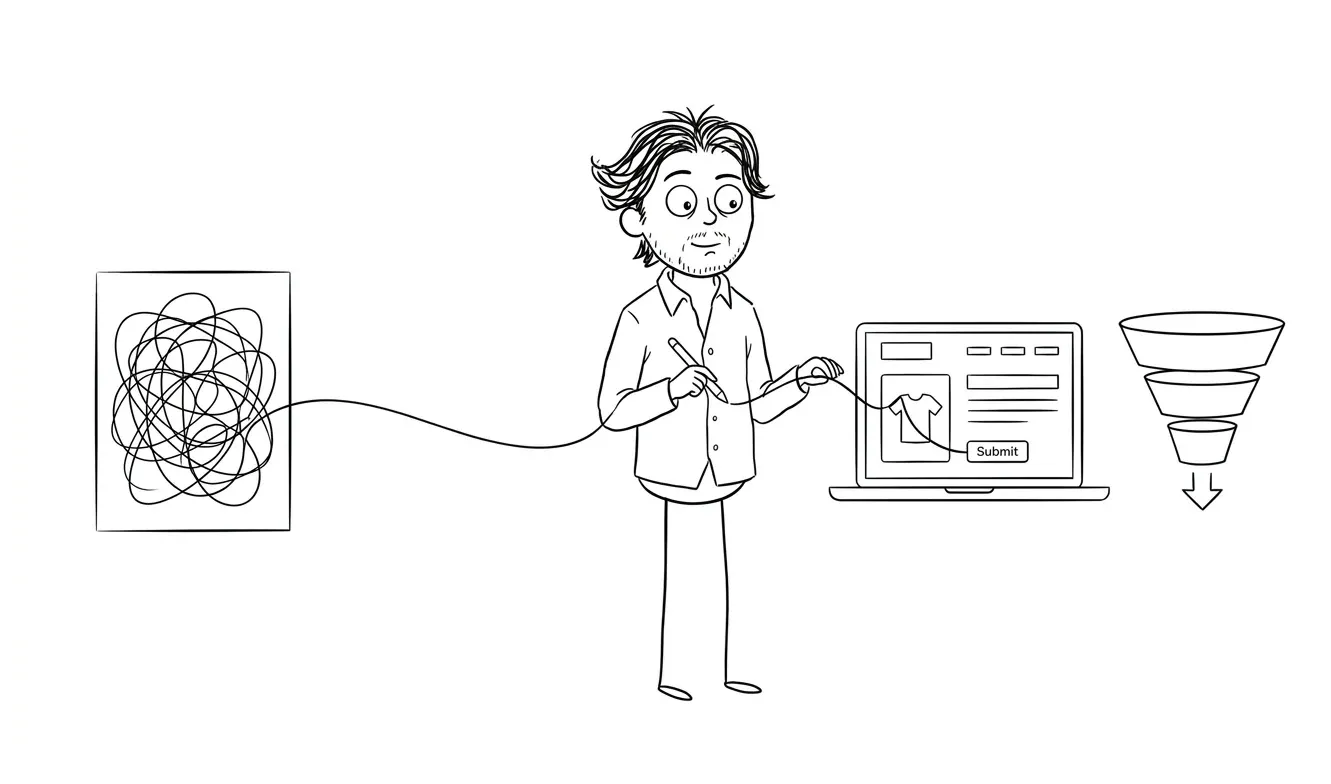
That’s not a promise, and results vary. But the frame matters. You’re not buying a document, you’re buying clarity on what to fix. If even one fix from the audit meaningfully improves conversion or retention, the audit paid for itself quickly.
According to Forrester Research, every dollar invested in UX can return between $2 and $100 depending on the type of product and what gets fixed. That’s a wide range, and you shouldn’t plan around the high end. But the underlying point holds: fixing the right thing early is almost always cheaper than fixing it after you’ve scaled the problem.
This is also why the Audit + Spec credit is structured the way it is. If the audit surfaces real work, you’ll probably want to fix it. The $500 becomes part of the implementation cost.
Thinking about a UX audit for your product? I offer a focused Audit + Spec for $500, credited toward follow-on work within 30 days. Tell me what you’re trying to figure out.
What the UX audit process looks like at dee.agency
It’s intentionally simple. No discovery calls before you’ve decided to move forward. No project kickoff ceremony.
- You fill out a short brief about your product and what you want reviewed.
- You pick a lens: UX friction, conversion, AI opportunity, or visibility.
- I review the product and any supporting data you share.
- You get a written spec with prioritized findings and clear next steps.
The whole thing takes a few business days. You can act on the spec immediately, hand it to your team, or use it to brief a developer. If you want me to handle the fixes, the $500 is credited toward that work.
It’s not a ceremony. It’s a focused answer to a specific question about your product.
If you’re also weighing whether it’s worth fixing issues yourself or bringing in outside help, the article on 7 signs your product needs a UX audit covers the decision from a different angle.
Frequently asked questions
How much does a UX audit cost for a small startup?
For a small startup, a focused UX audit typically costs between $300 and $2,500 depending on scope and who does it. The Audit + Spec at dee.agency is $500 for a single focused lens and is credited toward follow-on implementation work within 30 days.
How long does a UX audit take?
A focused single-lens audit from a solo practitioner takes two to five business days. A full agency audit with workshops and stakeholder interviews can take two to four weeks. Faster turnaround is usually a sign of tighter scope, not lower quality.
What’s the difference between a UX audit and a usability test?
A UX audit is a practitioner reviewing your product against experience and design principles. A usability test involves recruiting real users and observing how they interact with the product. Audits are faster and cheaper. Usability tests give you actual user behavior data. Both are valuable for different questions.
Is a $500 UX audit worth it?
Yes, if it’s scoped well and delivered by someone who knows what to look for. A cheap audit that produces a generic checklist isn’t worth $500. A focused audit that tells you exactly what’s causing drop-off and what to fix first is worth significantly more than $500. The key is specificity.
What should a UX audit deliverable include?
At minimum: specific friction points with explanations, prioritized recommendations, and a rough sense of effort for each fix. A spec that tells you what to build or change is more useful than a report that only describes what’s wrong.
Do I need a full audit or just a focused review?
Most early-stage founders need a focused review, not a full audit. Pick the one question your product most needs answered right now and audit through that lens. A full audit covering everything at shallow depth is usually less useful than a deep look at your biggest problem.
Get a clear answer on what’s actually hurting your product
If you’re wondering where users are dropping off, why your landing page isn’t converting, or what’s worth fixing first, an audit gives you a concrete answer.
The Audit + Spec at dee.agency is $500, covers one focused lens, and is credited toward design or development work within 30 days. You’ll walk away with a prioritized spec, not a deck.
Tell me about your product and what you want reviewed. We’ll go from there.

Got a project worth shipping? Send the brief.
Quote and kickoff date back in a day, usually faster. If it's not a good fit I'll say so.