

What Founders Get Wrong About AI Implementation
Most founders implement AI backwards. Here's what actually goes wrong and how to fix it before you waste time and money on the wrong tools.
Most founders get AI implementation wrong in the same way: they start with the tool instead of the problem. That’s the core of what founders get wrong about AI implementation, and it plays out constantly. They see a demo, get excited, and bolt something onto their product or workflow before they know what they actually need it to do. The result is a chatbot nobody uses, an automation that breaks weekly, or a six-month integration project that delivers nothing measurable. The fix is simpler than you’d think: find one painful, repetitive task, automate that first, and prove value before you build anything else.
I see the same mistakes come up whenever founders start planning AI integrations. The technology usually isn’t the hard part. The thinking before the technology is.
Here’s what actually goes wrong, and how to avoid it.
What founders get wrong about AI implementation from the start
The most common mistake happens before a single line of code gets written. A founder reads about AI agents, watches a demo on YouTube, or sees a competitor launch something shiny, and decides they need AI too. So they go looking for a use case to match the tool they already want to build.
That’s backwards.
The right way to start is to look at your actual operations. Where are you or your team spending time on repetitive, rule-based tasks? Where do things fall through the cracks because a human forgot to follow up? Where does information get entered into three different systems because nothing talks to each other?
Those pain points are your roadmap. The AI tool comes second.
I’ve seen founders spend $20,000 on a custom AI assistant for their sales team before they’d even mapped out their sales process. The assistant couldn’t help because nobody agreed on what “qualified lead” meant internally. The AI wasn’t the problem. The missing process was.
The founders who get the most out of AI aren’t the ones who implement the most tools. They’re the ones who implement the right tool for one specific, well-understood problem.
Start with a problem inventory, not a tool shortlist
Before you look at any vendor or platform, do this: spend 30 minutes writing down every task you or your team does that is repetitive, time-consuming, and follows a predictable pattern. Don’t filter by what feels automatable. Just list them.
Then rank them by time cost. Pick the top three. That’s your candidate list for your first AI project.
This sounds almost too simple, but most founders skip it. They go straight to researching tools because that’s more exciting. The problem inventory step is boring and it’s exactly why it works. You’re forcing yourself to define the problem before you fall in love with a solution.
a16z published a useful framework for thinking about where AI creates durable value in software products. The core insight is the same: value comes from solving a specific user or operator problem, not from adding AI as a feature layer.
Treating AI like a magic layer on top of a broken process
This one is so common it almost deserves its own article. A process that’s chaotic, undocumented, or inconsistent will stay chaotic after you add AI to it. AI amplifies what’s already there. If your customer support queue is a mess because your team doesn’t follow a consistent workflow, an AI chatbot will just create a faster, more automated mess.
Before you automate anything, you need to understand and stabilize the process manually. That sounds obvious, but founders who are excited about AI almost always skip this step.
The test I use: can you explain the process clearly enough that a new hire could follow it in a document? If the answer is no, you’re not ready to automate it.
Once you can document it, automating it becomes straightforward. I cover this approach in detail when I do AI integration work for clients. We spend the first part of the engagement just mapping what exists before touching any tooling.
The “let’s automate everything” trap
Related to the above: some founders flip from zero to 100. They don’t just want to automate one thing. They want to rebuild their entire operation with AI in one go.
This almost never works. It’s expensive, it takes forever, and when it breaks (it will break), you can’t tell what’s wrong because everything is interconnected.
Build one thing. Measure it. Then build the next thing.
I helped a SaaS founder recently who wanted to automate their entire onboarding flow, support function, and billing communications simultaneously. We talked them down to starting with just the onboarding email sequence, which was their biggest time sink. Three weeks later, that one automation was running reliably and saving them about four hours a week. Then we tackled support. Then billing comms.
Same end goal. Much more manageable path.
What founders get wrong about AI implementation: expecting instant ROI
AI implementation takes longer to show returns than most people expect. Not because the technology is slow, but because measuring impact takes time.
If you automate lead follow-up emails, you won’t know if your conversion rate improved until you have enough leads through the new system to have statistically meaningful data. That might take 30, 60, or 90 days depending on your volume.
Founders who expect week-one ROI get frustrated and abandon working automations too early. Or they tweak them constantly, which means they never have a stable baseline to measure against.
Pick a metric before you build. Decide in advance what success looks like and how long you’ll wait to evaluate it. Then leave the thing alone long enough to actually learn something.
The measurement problem
A lot of founders can’t tell whether their AI implementation worked because they didn’t set up any tracking. They built the thing, turned it on, and hoped for the best.
At minimum, before you launch any AI automation, you should know:
- What metric are you trying to move?
- What was the baseline before the automation?
- What’s the time window for evaluation?
- Who’s responsible for checking and reporting on it?
Without this, you’re just adding complexity to your business and calling it an improvement.
What good looks like before you build
Here’s a simple table I walk clients through before we start any automation project. If you can’t fill this out, you’re not ready to build yet.
| Question | Example answer |
|---|---|
| What task are we automating? | Lead follow-up emails after demo request |
| How long does it take manually? | 15 minutes per lead |
| How many times per week? | ~20 leads |
| What’s the success metric? | Response rate, time-to-first-contact |
| What’s the current baseline? | 38% response rate, avg 4 hours to first contact |
| When will we evaluate? | After 60 days / 80 leads |
Fill that out and you’ve done more pre-work than most teams do before spending real money on implementation.
Underestimating the maintenance burden
AI tools need babysitting. Not constant babysitting, but regular check-ins. Models get updated by their providers and behavior changes. Prompt engineering that worked in January sometimes stops working in March. APIs evolve. Rate limits change.

Founders often treat an AI integration like a piece of furniture. You buy it, put it in the room, and forget about it. That’s not how this works.
When I build automations for clients, I always include a maintenance plan in the conversation. Who’s going to own this? How often will they check on it? What’s the process when something breaks?
If nobody owns the AI tool after launch, it will degrade quietly until it fails completely at the worst possible time.
This is also why I’m skeptical of overly complex multi-step AI pipelines for early-stage companies. The more moving parts, the more surface area for something to go wrong. Start simple. You can always add complexity later.
If you want to understand how AI systems fit into practical operations, start with the AI service overview before adding complex agent orchestration.
What a basic maintenance routine looks like
You don’t need much. For most small business automations, a monthly check covers it:
- Run the automation manually on a test case and check the output quality.
- Review any error logs from the past 30 days.
- Check if the underlying model or API has had any version updates.
- Ask whoever uses the output daily if anything has felt off recently.
That’s maybe an hour a month. Skipping it is how you end up with a broken automation that’s been sending weird emails to customers for six weeks before anyone notices.
The OpenAI changelog and equivalent pages for whatever APIs you’re using should be on your monthly reading list if you’re running AI in production. Model behavior changes happen, and they’re not always announced loudly.
Buying tools instead of solving problems
There’s a category of founders who are essentially tool collectors. They’ve got an AI writing assistant, an AI scheduling tool, an AI SEO tool, an AI CRM tool, and an AI tool to summarize their other AI tools. None of them talk to each other. None of them are being used to their potential.
This happens because software demos are compelling and the monthly subscription fees feel low at the time. But $49/month across 12 tools is $588/month on tools you’re not using well. And you’re paying with your attention every time you context-switch between them.
The question to ask before adding any AI tool: what is the one concrete outcome I expect from this, and what does my workflow look like after I add it?
If you can’t answer both parts clearly, don’t add the tool yet.
Adding AI tools without a clear workflow change is just adding subscriptions.
Delegating AI decisions to people who don’t understand the business
This one’s less common but more expensive when it happens. A founder, recognizing they’re not technical, hands the entire AI strategy to a developer or an agency. The developer builds what they think is cool or what they know how to build. The result often solves a technical problem rather than a business problem.
AI implementation decisions need to stay close to whoever understands the actual business problem. That doesn’t mean the founder has to write the code. But they should be defining the problem, validating the output, and deciding when something is working well enough to ship.
I see this dynamic in my MVP engagements sometimes too. Founders who stay close to the product decisions end up with something they can actually sell. Founders who fully delegate come back with something technically impressive that doesn’t quite fit what their customers need.
You don’t need to be technical to own the problem definition. You just need to stay in the conversation.
When to bring in outside help
There’s a flip side to this. Some founders try to do everything themselves and get stuck. They read about LangChain for two months, build half a prototype, and can’t ship.
If you’ve been trying to build a specific automation for more than a few weeks and you’re still not live, it’s worth getting help. Not because you can’t figure it out, but because the opportunity cost of not shipping is real.
My AI integration service is built for exactly this situation. Flat fee, defined scope, ships in a few weeks. No retainer, no ongoing dependency.
Stuck on an AI implementation? I offer a flat-fee AI integration service for founders who want to go from idea to working automation without months of back-and-forth. Tell me what you’re trying to build.
Ignoring the human side of AI rollout
The last mistake on this list is underestimating how resistant people can be to AI tooling, even when it makes their job easier.
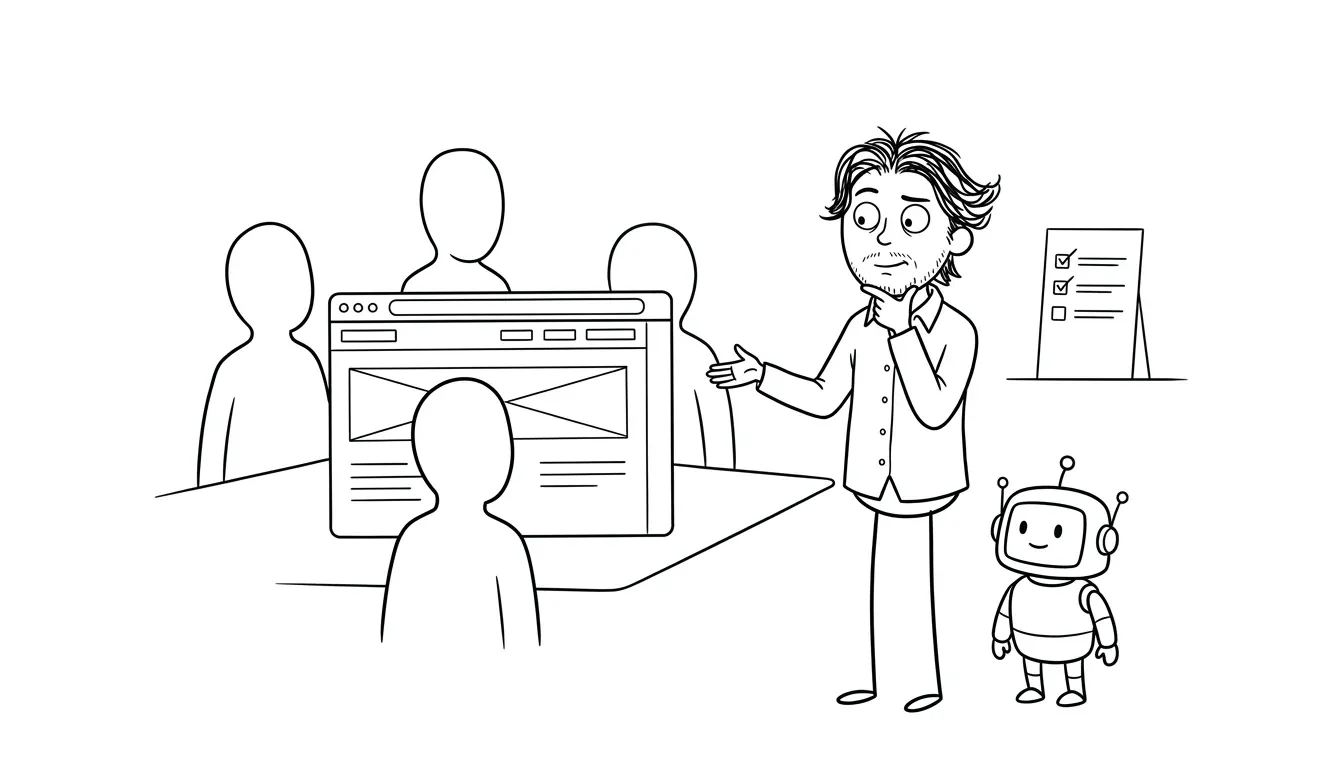
If you’re rolling out an AI tool that changes how your team works, communication matters as much as implementation. People need to understand why you’re introducing the tool, how it changes their workflow, and what happens to their role.
Founders who skip this step often find their AI tools unused. The team works around them, reverts to the old way, and the automation sits there collecting dust.
Run a proper rollout. Train the people who will use it. Check in after two weeks. Adjust based on feedback.
This isn’t unique to AI. It’s standard change management. But AI tools tend to trigger more anxiety than a new project management app because of how they’re covered in the press. People worry about their jobs. Acknowledge that directly and clearly. Explain what the tool does and what it doesn’t do.
McKinsey’s research on technology adoption in organizations consistently shows that communication and involvement in the rollout process are the strongest predictors of whether new tools actually get used. AI is no different.
AI is a change management problem as much as a technical one.
For more on what actually works in AI implementation for small businesses, my article on AI automation for small business breaks this down with specific examples.
Frequently asked questions
What’s the biggest mistake founders make with AI implementation?
Starting with a tool instead of a problem. Most founders see a compelling AI demo and then go looking for something in their business to apply it to, rather than identifying their most painful workflow and finding the right tool for that specific situation.
How long does AI implementation actually take to show ROI?
Typically 30 to 90 days before you have enough data to evaluate impact, depending on your volume and what you’re automating. Set a measurement baseline before you launch anything and give the automation time to run before you judge it.
Should founders build AI tools themselves or hire someone?
It depends on your technical skills and how long you’ve been stuck. If you’ve spent more than a few weeks trying to build something and you’re still not live, the cost of not shipping outweighs the cost of hiring help. My AI integration service is a flat-fee engagement that gets you from idea to working automation in a few weeks.
What should I automate first?
Whatever is eating the most repetitive time. Look for tasks that are consistent, rule-based, and happen frequently. Onboarding emails, lead follow-up sequences, internal reporting, and data entry between tools are common good starting points for early-stage companies.
Why do AI chatbots fail so often?
Usually because they’re built before the underlying process is stable or documented. A chatbot can’t help customers effectively if your support process is inconsistent or your knowledge base is incomplete. Fix the process first, then automate it. I go deeper on this in my article about why AI chatbots fail.
How much does AI integration cost for a small business?
It varies a lot depending on scope, but a focused integration for one specific workflow, built by a solo practitioner, typically runs between $3,000 and $10,000. My AI integration service is a flat $3,000 for a defined automation scope. Agencies will charge significantly more for the same scope.
Ready to implement AI without the guesswork?
If you’ve been thinking about adding AI to your product or workflow but aren’t sure where to start, or if you’ve started and gotten stuck, I can help. My AI integration service is a flat-fee engagement, no retainer, no ongoing dependency. We scope the right automation, build it, and ship it.
Tell me about your project and we can figure out if it’s a good fit.

Got a project worth shipping? Send the brief.
Quote and kickoff date back in a day, usually faster. If it's not a good fit I'll say so.