

How to Go From Idea to Launched Product in 3 Weeks
A practical week-by-week guide to shipping an MVP in 3 weeks. Real scope, real decisions, real launch. No process theater.
Going from idea to launched product in 3 weeks is possible, but only if you scope ruthlessly, skip the process theater, and build the smallest thing that proves your idea works. I do this regularly through my Idea to MVP service at dee. agency. The formula is consistent: one week of focused definition, one week of design and build, one week of polish and launch. The constraint is the point. Three weeks forces you to make real decisions instead of deferring them.
Why most founders never launch
The average founder I talk to has been “working on their idea” for three to six months. They’ve got wireframes, a Notion doc full of features, maybe a Figma file someone made for them. But nothing is live.
That’s not a work ethic problem. It’s a scoping problem.
When you have unlimited time and no hard deadline, every feature feels necessary. You add edge cases. You debate the color of a button. You redesign the onboarding flow for the fourth time because you watched another startup’s teardown video.
A three-week deadline kills all of that. You can’t debate the secondary user persona when you’ve got 21 days to ship.
The goal isn’t to build the perfect product. It’s to build something real enough that actual users can tell you what’s wrong with it.
That shift in mindset is everything. Let me walk you through exactly how the three weeks work.
Week 1: Define what you’re actually building
This is the week most people rush through, and it’s the one that determines whether week three ends with a launch or another delay.
The one-sentence product description
Before you open Figma or write a line of code, you need to be able to finish this sentence:
“[Product name] helps [specific person] do [specific thing] so they can [specific outcome].”
No vague “platform for creators” or “tool for teams.” Specific. If you can’t write this sentence clearly in 10 minutes, you’re not ready to build yet.
The 5-feature limit
Write down every feature you want to build. Then cut it in half. Then cut it in half again.
What’s left is your MVP scope.
I’m serious. If you’re building a project management tool, your launch version probably needs: create a project, add tasks, mark them done, and invite one other person. That’s it. No recurring tasks, no integrations, no reporting dashboard, no custom fields.
The features you cut aren’t gone forever. They’re version two. Version two ships after version one has real users.
Validate before you build
Three weeks is tight enough that you can’t afford to build something nobody wants. Spend the first two or three days of week one doing the fastest possible validation.
That might mean:
- Five 20-minute calls with people in your target market
- A quick landing page that describes the product and collects emails (I can build that in a day through my landing page service)
- Posting in a relevant community and watching the reaction
You’re not looking for a green light. You’re looking for the questions people ask, the language they use to describe the problem, and whether they’d actually pay.
Technical decisions
By the end of week one, you need to have decided:
- What stack you’re building on
- What you’re NOT building yourself (auth, payments, email, storage are all solved problems in 2025)
- Where it will be hosted
Reach for boring, proven tools. Next.js, Supabase or Firebase, Stripe for payments, Resend for email. The goal isn’t an interesting technical architecture. The goal is a working product in three weeks.
Week 2: Design and build simultaneously
This is where most traditional processes fall apart. Agencies hand off designs to developers. Developers ask questions the designers didn’t think about. Designs get revised. Everyone waits.
When you’re moving this fast, design and build have to happen together. You design a screen, you build it. You don’t hand off a 40-screen Figma file and wait for implementation. You work screen by screen, flow by flow.
Design only what you’re about to build
Don’t design the whole product before touching code. Design the first screen. Build it. Design the next screen. Build it.
This sounds chaotic but it’s faster in practice. By the time you’re building screen five, you’ve already learned things from screens one through four that would have made your upfront design wrong anyway.
Component-first thinking
Pick a component library and stick with it. shadcn/ui, Radix, Mantine, whatever. The point is to stop designing buttons and modals from scratch. Those decisions don’t matter at launch. Use an existing system and customize just enough to feel like your brand.
The two-question test for every feature
As you build, you’ll constantly want to add things. Before adding anything, ask:
- Does a user need this to complete the core flow?
- Will the product fail without it?
If both answers are no, it doesn’t get built this week.
Build the critical path only
Map out the exact steps a user takes from landing on your site to getting the core value of your product. That path gets built perfectly. Everything outside that path is optional.
For a task management tool: land on marketing site, sign up, create a project, add a task, mark it done. That’s the critical path. The settings page, the profile editor, the integrations section, all of that comes later.
A real example: what this looks like in practice
I built a client feedback tool for a small agency in two weeks of actual build time. The full feature wishlist had 22 items on it. We launched with five: share a link, leave timestamped comments on a video, reply to comments, mark a comment resolved, and download a PDF summary.
That’s it. No user roles, no integrations, no white-labeling. The agency used it with their first three clients before we touched any of the other 17 features. Two of those features turned out to be things nobody actually asked for. We never built them.
That’s what scoping down to a critical path actually saves you. Not just time. Wasted work.
How to go from idea to launched product in 3 weeks without burning out
Three weeks is a sprint. It’s intense. Here’s how to make it sustainable.

Work in 4-hour blocks, not marathon sessions
Eight-hour coding days feel productive but they’re usually not. Your best decisions happen in the first four hours. After that, you’re pushing pixels and writing code you’ll rewrite tomorrow.
I work in one focused block in the morning and use the afternoon for async feedback, email, and lower-stakes work. That rhythm is sustainable for three weeks. Fifteen-hour days are not.
Make decisions and move
The biggest time killer isn’t technical complexity. It’s indecision. You spend two hours on the color palette. You rewrite the homepage headline five times. You can’t pick between two database schemas.
Pick something. Ship it. Change it later if it matters.
Almost every decision you make in week two can be undone. Almost none of them will matter as much as you think.
Get feedback on Tuesday and Thursday, not constantly
Don’t ask for feedback every time you finish something. That creates noise. Instead, share what you’ve built twice a week and batch the input.
This keeps you building instead of responding, and it gives your feedback-givers enough to actually evaluate.
What kills the timeline
I’ve seen three-week sprints go sideways in pretty predictable ways. The most common ones:
- Waiting on a third-party tool to approve an API key (apply on day one, not day eight)
- A design stakeholder who wants to see options at every step (agree upfront that you’re making calls and moving)
- Switching the tech stack mid-week because something felt slow (it’s never as slow as you think)
- A founder who discovered a competitor and wants to add their best feature before launch
None of these are catastrophic if you catch them early. All of them are project-ending if you don’t.
How to go from idea to launched product in 3 weeks: the decisions that matter most
Most of what determines whether you ship in three weeks gets decided in the first 72 hours. The tech choices, the scope, the definition of done. Get those right and week two almost runs itself. Get them wrong and no amount of late nights in week three saves you.
Here are the calls that actually move the needle.
Define “done” on day one
Not “the product is finished.” That’s not a definition. Done means: a new user can sign up, complete the core action, and get the result the product promises, without you helping them.
Write that down. Stick it somewhere visible. Every feature debate goes back to that definition. If it’s not required for that experience, it’s not in scope.
Pick your “no meetings” rule early
If you’re building with a co-founder or hiring someone to build with you, agree upfront that feedback happens async and decisions don’t require a call. Read how I handle this in my own process in why I work async-only. Synchronous coordination is the fastest way to lose a day.
Decide what “good enough” looks like for design
You don’t need a custom design system for a three-week MVP. You need something that looks credible enough that users trust it with their email address or credit card. That’s a much lower bar than most founders set for themselves.
Use a component library. Pick a neutral color palette. Spend your design energy on the core flow, not the marketing page. A mediocre marketing page with a great product still converts.
Week 3: Polish, test, and ship
Week three is not when you add features. It’s when you make what you’ve built feel real.
The 5-person user test
Find five people who’ve never seen your product. Watch them try to use it. Don’t explain anything, don’t help them, just watch.
You’ll see the same two or three confusing spots come up every time. Fix those. Everything else is noise.
This isn’t formal usability research. It’s a quick gut check that your core flow isn’t broken. Five people is enough to find the obvious problems. Nielsen Norman Group’s research has shown this for decades and it still holds.
Fix the critical path, ignore the edges
After the user tests, you’ll have a list of things to fix. Prioritize ruthlessly. Anything that breaks the critical path gets fixed. Anything that’s annoying but workable gets logged for post-launch.
This is hard. You’ll want to fix everything. Don’t.
Pre-launch checklist
Before you ship, make sure:
- The core flow works end to end without errors
- Payments actually process (test mode and live mode)
- Emails send (confirmation, password reset, the basics)
- It works on mobile (not perfect, just functional)
- You have a way to see errors when they happen (Sentry or LogRocket, 10 minutes to set up)
- Analytics are in (one tool, Posthog or Plausible, that’s enough)
That’s it. You don’t need a perfect error handling system. You don’t need automated testing coverage. You need those six things.
Launch small on purpose
Your first launch shouldn’t be a big announcement. Post in one community. Email your waitlist. DM 10 people who might care.
Watch what happens. See where people get stuck. Talk to anyone who signs up in the first 48 hours.
A small launch is information. A big launch you’re not ready for is a reputation problem.
When to hire someone vs.build it yourself
If you can design and code, you can probably do this alone. If you can only do one, you need help for the other.
The math is simple. Three weeks at $9,000 for a fully designed and built MVP is a lot cheaper than three months of hiring, managing, and coordinating a team. And it’s faster.
That’s exactly what my Idea to MVP service covers. You bring the idea and the domain knowledge. I handle the design, the build, and the launch. Three weeks, flat fee, no hourly billing surprises.
If your product is already built but you’re not sure why it’s not converting, a UX audit makes more sense as a starting point.
Need help shipping your MVP fast? My Idea to MVP service takes you from concept to launched product in three weeks, flat fee. Tell me about your project.
What this timeline actually looks like
| Phase | Days | Output |
|---|---|---|
| Define scope | Days 1-3 | One-sentence brief, 5-feature list, validated idea |
| Technical setup | Days 4-5 | Stack chosen, repo set up, component library picked |
| Core build | Days 6-12 | Critical path built and working |
| User testing | Days 13-14 | 5 testers, top issues identified |
| Polish and fix | Days 15-18 | Critical issues resolved, edge cases logged |
| Pre-launch | Days 19-20 | Checklist done, analytics in, errors tracked |
| Launch | Day 21 | Soft launch to first audience |
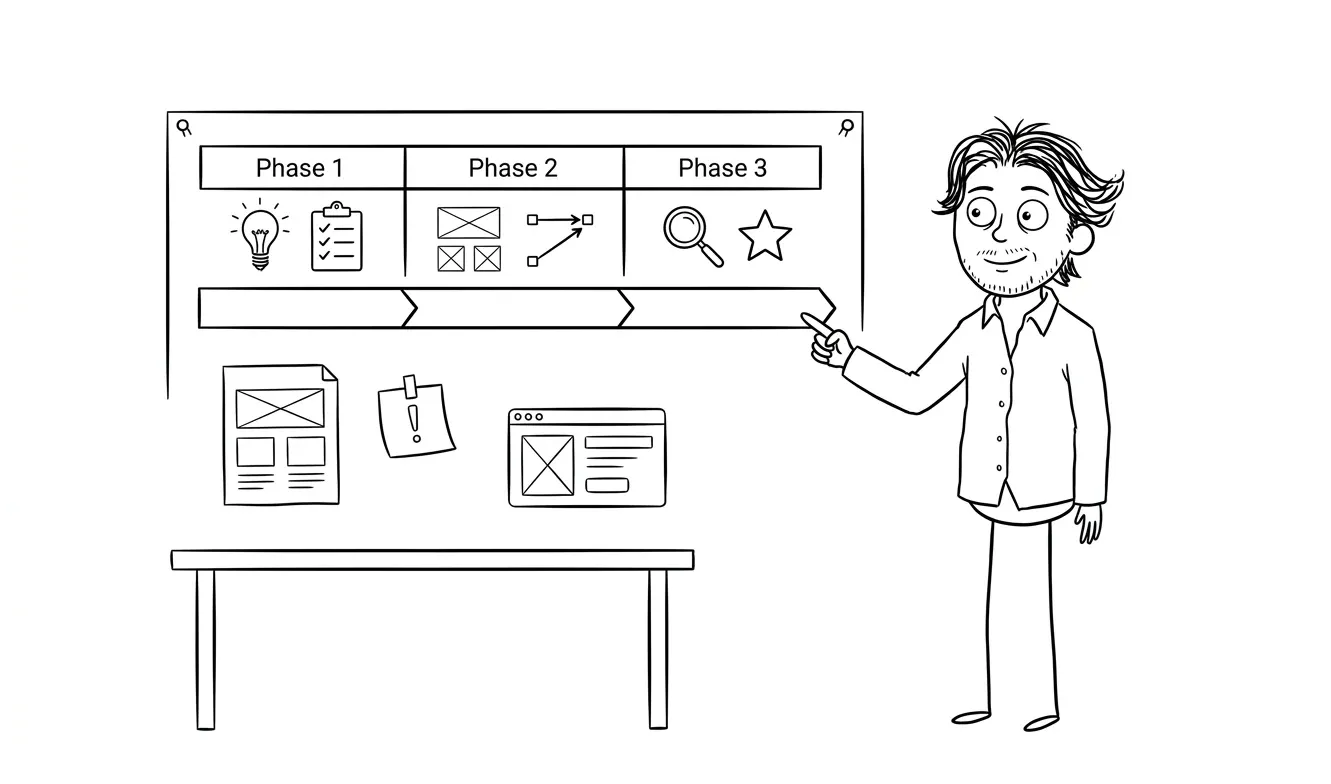
This isn’t a rigid schedule. Some builds hit unexpected complexity in week two and need an extra two or three days. That’s fine. The structure keeps you honest.
The difference between an MVP and a bad product
An MVP is not a half-built product. It’s a fully functional product with a deliberately narrow scope.
The login screen should work perfectly. The core action should work perfectly. The payment flow should work perfectly. The rest can wait.
Users will forgive a missing feature if what’s there works well. They won’t forgive a broken experience.
That’s the real lesson from shipping fast. Speed doesn’t mean sloppy. It means focused.
Frequently asked questions
Can you really go from idea to launched product in 3 weeks?
Yes, but only with a tight scope. Three weeks is enough to design, build, and ship a functional product if you limit yourself to five features or fewer and skip anything that isn’t on the critical user path. I ship MVPs in this timeframe regularly through my Idea to MVP service.
What’s the minimum viable product for a SaaS?
At minimum, a SaaS MVP needs: a working signup and login, the core feature that delivers the product’s main value, a way to charge users, and basic email notifications. That’s it. Everything else is version two.
How much does it cost to build an MVP in 3 weeks?
Costs vary widely depending on who builds it. A solo designer-developer like me charges a flat $9,000 for a full MVP. Agencies typically charge $30,000 to $80,000 for similar scope. Freelancer marketplaces are cheaper but slower to coordinate. See my full MVP cost breakdown for a detailed comparison.
What tech stack should I use for a fast MVP?
Next.js for the frontend, Supabase or Firebase for the backend and auth, Stripe for payments, and Vercel for hosting. This stack is fast to set up, well-documented, and has enough free tier to get you to your first paying users without infrastructure costs.
What’s the biggest mistake founders make when trying to launch fast?
Scope creep in week one. Founders agree on five features, then quietly add two more “small” ones by day four. Those small additions compound. By week three, you’re not done. Lock your scope on day three and treat any new feature request like a threat to your launch date.
Do I need a co-founder to launch in 3 weeks?
No. A single person who can design and build, or a founder who hires a solo studio, can ship in three weeks. Adding more people usually adds coordination overhead that slows things down at this stage. More hands help after launch, when the scope is clear and the product is real.
Ready to ship your idea?
If you’ve been sitting on an idea and want to see it live in three weeks, my MVP service is built for exactly this. Flat fee, async process, no drawn-out agency timeline.
Tell me about your project and I’ll let you know if it’s a fit.

Got a project worth shipping? Send the brief.
Quote and kickoff date back in a day, usually faster. If it's not a good fit I'll say so.