

AI visibility service page checklist
Fix your service page so ChatGPT, Perplexity, and Gemini can understand and cite your offer. 11-step AI visibility checklist for founders.
An AI visibility service page checklist covers eleven areas: entity clarity, direct offer statements, buyer Q&A, audience definition, process and pricing transparency, structured headings with FAQ schema, internal linking, crawler access, llms.txt, and tracking. Fix these on one service page and answer engines like ChatGPT, Perplexity, and Gemini have enough signal to understand your offer and cite it when buyers ask relevant questions. Skip them and even a well-written page stays invisible in AI search.
Why your service page isn’t getting cited in AI answers
Answer engines don’t crawl pages the way Google does and then rank them by backlinks. They pull from what they’ve indexed, synthesize it, and return a confident answer. If your page doesn’t clearly state what you do, who it’s for, and how it works, the model has nothing useful to quote.
This isn’t abstract. When someone asks ChatGPT “what’s the best AI visibility service for startups” or Perplexity “who helps with generative engine optimization,” the answer comes from pages that made those facts legible. Vague hero copy, buried pricing, and dense paragraphs don’t make the cut.
The fix isn’t a full redesign. It’s a structured pass through your service page, checking each element against what answer engines need to read and cite.
This checklist is for one page at a time. Pick your highest-value service page and run through it. Then repeat.
The AI visibility service page checklist
Here’s the sequence. Work top to bottom. Each section builds on the last.
1. State your entity and offer in the first paragraph
Answer engines need to know who you are and what you sell before anything else. Your opening paragraph should name your business (or your name if you’re a solo operator), state the service clearly, and include the category.
Bad: “We help businesses grow through innovative digital strategies.”
Better: “dee.agency offers an AI visibility service for early-stage startups that want to show up in ChatGPT, Perplexity, and Google AI Overviews. The service is called GEO Fix, which stands for generative engine optimization.”
The entity (dee.agency, Dee Kargaev), the offer (AI visibility service), and the category (GEO / generative engine optimization) all appear in the first 100 words. That’s what models need to associate your page with a topic.
Don’t save the clear explanation for the middle of the page. Put it first.
2. Include a one-sentence “what this is” definition
Every service page should have a single sentence that could be lifted verbatim into an AI answer. Think of it as a definition block.
For an AI visibility service, that might look like:
Generative engine optimization (GEO) is the practice of making your service pages legible to AI answer engines like ChatGPT, Perplexity, and Gemini so they include your business in relevant responses.
Put this near the top, in its own paragraph or as a short blockquote. Models are more likely to quote text that’s already formatted as a definition or a standalone statement.
3. Answer buyer questions directly, in plain text
This is where most service pages lose AI citations. They tell a story instead of answering questions.
Answer engines are trained to find the best answer to a question. If your page has a conversational narrative but doesn’t actually answer “how much does this cost” or “how long does this take” or “who is this for,” a model skips your page and finds one that does.
Go through your page and map it against the five questions a serious buyer asks:
- What exactly is this service?
- Who is it for?
- How does it work?
- What does it cost?
- What do I get at the end?
Each question should have a direct answer somewhere on the page. Not buried in a paragraph, not hinted at in a testimonial. A plain declarative sentence.
4. Define your audience explicitly
Vague audience language (“businesses of all sizes,” “founders and executives”) doesn’t help models match your page to queries. Specific audience language does.
State clearly who this is for. One or two sentences, no hedging.
Example: “This service is for early-stage B2B startups and solo founders who want their service pages cited in AI-generated answers but don’t know where to start.”
If you have a secondary audience (agencies, consultants, operators), add a second sentence. Don’t combine them into one fuzzy sentence that covers everyone.
Explicit audience signals help models route your page to the right queries. “Who should use this” is one of the most common question types in AI search.
5. Use structured headings that mirror real questions
Your H2 and H3 headings are the skeleton that answer engines read first. If your headings are vague (“Our approach,” “The process,” “Why us”), a model can’t extract meaning from them.
Rewrite vague headings as question-based or declarative statements:
| Vague | Better |
|---|---|
| ”Our approach" | "How the AI visibility audit works" |
| "Why us" | "What makes this different from traditional SEO" |
| "The process" | "What happens after you book" |
| "Results" | "What you get at the end of the engagement” |
You don’t need every heading to be a question. But headings should describe the content below them accurately enough that someone reading only the headings gets the full picture.
6. Add a transparent pricing and deliverables section
Pricing transparency is one of the highest-signal things you can do for AI visibility. Models are frequently asked “how much does X cost” and the pages that answer directly get cited. Pages that say “contact us for a quote” don’t.
If you have flat-fee pricing, show it. If pricing varies, give a range and explain what drives it.
For each service tier or option, list:
- The price (or range)
- What’s included
- What’s not included
- Approximate timeline
This doesn’t need to be a long table. A few sentences per item is enough. The goal is that a model can extract a specific, accurate answer to “how much does this cost” from your page.
Want a service page that answers buyer questions clearly enough for AI to cite it? My AI Visibility / GEO Fix service covers exactly this. Tell me what you’re working on.
7. Add an FAQ section with structured markup
An FAQ section at the bottom of your service page does two things. First, it answers the long-tail questions buyers actually type into AI search. Second, when you add FAQ schema (structured data / JSON-LD), you give crawlers a machine-readable version of those Q&A pairs.
Google’s FAQ schema documentation explains the exact format. The implementation is straightforward: a JSON-LD block in your page <head> or body that lists each question and its answer.
Write four to six questions that match how buyers actually ask things. Don’t write questions that are secretly sales pitches (“Is dee.agency the best AI visibility service?”). Write questions that a real buyer would type.
Examples for an AI visibility service page:
- “What is generative engine optimization?”
- “How long does it take to show up in AI search results?”
- “Do I need to rewrite my whole website?”
- “What’s the difference between GEO and SEO?”
- “Is this service for B2B or B2C companies?”
Answer each one in two to four sentences, directly and without filler.
For more on how structured data affects AI citation, I’ve written a full guide on schema markup for AI visibility that covers the specific types most useful for service pages.
8. Add internal links to related pages and topics
Internal links help answer engines map your site’s topical coverage. A service page that links to related articles, adjacent services, and your about page tells a model that this entity covers this topic seriously.
Don’t just link for SEO. Link where it genuinely helps a reader understand more. A few practical spots on a service page:
- Link your “how it works” section to a related article explaining the process in more depth
- Link your pricing section to a comparison article if you have one
- Link your about/author section to your main about page
- Link adjacent services where they’re genuinely relevant
Three to five internal links per service page is a reasonable target. More than that starts to feel forced.
9. Verify crawler access for AI bots
None of this matters if AI crawlers can’t read your page. Check your robots.txt file and make sure you’re not accidentally blocking the bots that feed AI answer engines.
The retrieval bots you want to allow include OAI-SearchBot (OpenAI’s retrieval bot for ChatGPT search), PerplexityBot, and GoogleBot (which feeds Google AI Overviews). OpenAI’s crawler documentation and Bing’s webmaster documentation list the exact user-agent strings.
A robots.txt that blocks all unknown bots or uses a wildcard deny can quietly cut off AI indexing without you noticing. Check it now.
Also check that your page isn’t hidden behind a login, a JavaScript render that can’t be crawled, or a noindex tag left over from a staging environment. These are common enough that they’re worth five minutes to verify.
10. Add an llms.txt file to your site root
llms.txt is a plain-text file you place at yourdomain.com/llms.txt that gives AI models a curated summary of your site: who you are, what pages exist, and how you want your content interpreted. It’s not an official standard yet, but the proposal has traction and several major tools already check for it.
For a service business, a basic llms.txt might look like this:
# dee.agency

> One-person design, code, and AI studio for founders.

## Services
- [AI Visibility / GEO Fix](https://dee.agency/geo): $3,000 flat-fee service for making service pages legible to answer engines.
- [Audit + Spec](https://dee.agency/audit): $500 focused diagnostic, credited toward follow-on work within 30 days.
- [Landing Page Design & Build](https://dee.agency/landing-page): $3,000 for a complete landing page.
- [AI Integration & Automation](https://dee.agency/ai): $3,000 for one useful AI workflow or integration.
- [Idea to MVP](https://dee.agency/mvp): $9,000 to take an idea to a working product.
It’s short, factual, and machine-readable. A model that checks for llms.txt gets a clean, curated summary of your entity instead of having to infer it from scattered page copy.
11. Track citation and query changes over time
Making changes without tracking them means you don’t know what’s working. Set up a basic before/after baseline before you start fixing anything.
Do a few manual spot-checks: ask ChatGPT, Perplexity, and Gemini about the problem your service solves and see whether your business gets mentioned. Screenshot the results. Date them.
After you’ve made changes and given crawlers a few weeks to re-index, run the same queries again. You won’t have perfect attribution, but directional signal is enough to know whether the changes are moving things.
You can also set up Google Search Console to monitor organic visibility changes in parallel. AI answer engines don’t feed directly into GSC, but your branded query volume and referral traffic from AI tools are both worth watching.
What order should you fix these in?
If your page has none of these fixes in place, start with 1-3 (entity, definition, buyer Q&A). Those are the foundation. Without them, nothing else matters much.
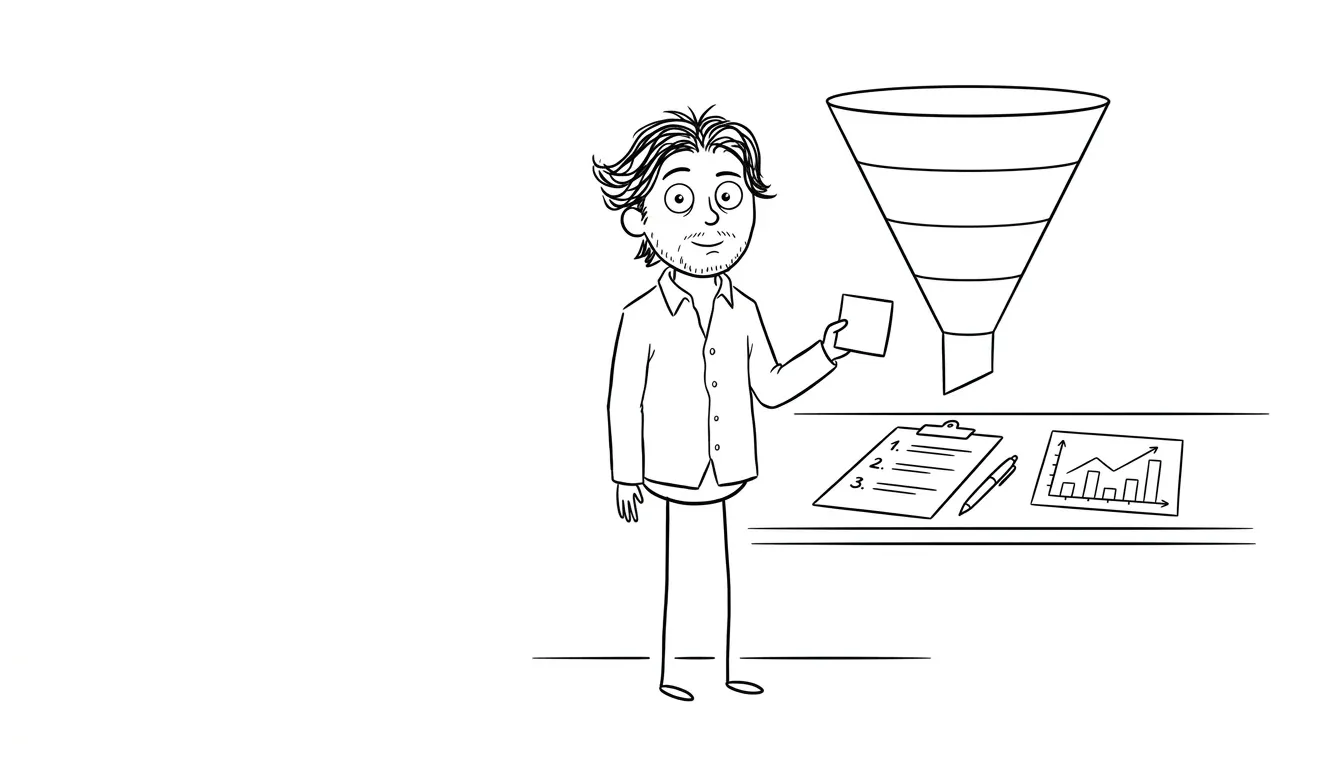
Then do 4-6 (audience, headings, pricing). Then 7-9 (FAQ schema, internal links, crawler access). Then 10-11 (llms.txt, tracking).
If your page is already solid on the basics, go straight to 7 and 9. Those two are the most commonly skipped and have clear, verifiable implementations.
The whole checklist for one service page takes a focused half-day. Longer if you need to rewrite significant sections of copy.
If you want a second set of eyes before you start, my Audit + Spec service gives you a focused diagnosis of exactly what’s blocking your page’s AI visibility, for $500. The fee is credited toward the GEO Fix if you book within 30 days.
Frequently asked questions
What is an AI visibility service page checklist?
It’s a structured list of fixes for a single service page that help AI answer engines understand, index, and cite your offer. It covers things like entity clarity, direct buyer Q&A, structured headings, FAQ schema, pricing transparency, and crawler access. Running through it on one page typically takes a focused half-day.
Do I need to rewrite my whole website to show up in AI search?
No. Start with one page, your most important service page. Fix the entity statement, add direct answers to buyer questions, check your robots.txt for crawler access, and add an FAQ section with schema markup. Those changes on one page can meaningfully improve how answer engines read and cite your offer.
What’s the difference between GEO and SEO?
SEO (search engine optimization) focuses on ranking in traditional search results through keywords, backlinks, and technical factors. GEO (generative engine optimization) focuses on making your content legible enough for AI answer engines to cite you when they synthesize responses. Both matter, but they reward different signals. SEO prioritizes backlink authority; GEO prioritizes clear, direct, factual content.
Should I add llms.txt to my site?
If you run a service business and want AI models to accurately represent your offer, yes. It’s a low-effort addition: a plain-text file in your site root that summarizes your entity, services, and key pages in a format AI tools can parse easily. It’s not an official standard yet, but it has enough adoption to be worth including.
How do I know if AI answer engines are citing my page?
Manual spot-checking is the most direct method: ask ChatGPT, Perplexity, and Gemini about the problem you solve and note whether your business appears. Do this before and after making changes, with a few weeks between checks to allow re-indexing. Monitoring branded query volume in Google Search Console can also give directional signal.
How long does it take for AI search changes to take effect?
There’s no fixed timeline because AI answer engines don’t publish their indexing schedules. Most practitioners observe changes within a few weeks of a crawler re-visiting a page. Making your changes and then verifying crawler access (via robots.txt and no noindex tags) is the best way to speed things up.
Ready to make your service page legible to AI answer engines?
If you want this done properly without spending a week on it yourself, that’s what my AI Visibility / GEO Fix service is for. It’s a flat-fee $3,000 engagement focused on making your service pages citable in AI search. Or if you want a focused diagnosis first, the $500 Audit + Spec covers one lens, and the fee credits toward the full service.
Tell me about your project and we’ll figure out where to start.

Got a project worth shipping? Send the brief.
Quote and kickoff date back in a day, usually faster. If it's not a good fit I'll say so.