

How to Scope an MVP Without Overbuilding
Learn how to scope an MVP without overbuilding: define your riskiest assumption, cut everything else, and ship something that actually validates your idea.
Scoping an MVP without overbuilding means defining the smallest version of your product that proves your core assumption, then cutting everything else. Most founders overbuild because they’re solving imaginary problems before real users confirm they exist. The right approach: write down your single riskiest assumption, list every feature you think you need, and cut anything that doesn’t directly test that assumption. What’s left is your MVP scope. At dee.agency, the Idea to MVP service is built around this exact discipline.
Why overbuilding kills MVPs before they launch
You have an idea. You’re excited. You start listing features, and the list grows, and suddenly your “MVP” is a six-month project with a backend, an admin panel, a mobile app, onboarding flows, a dashboard, and three integrations you’ll “definitely need.”
Then you run out of money. Or time. Or both.
This is the most common way early-stage products fail. Not because the idea was bad, but because the scope was untethered from any real validation goal.
Overbuilding isn’t just a budget problem. It’s a thinking problem. Founders add features because features feel productive. Every item you add to a spec feels like progress. But if none of those features have been tested against real users with a real problem, you’re not making progress. You’re making assumptions.
The goal of an MVP isn’t to impress investors or feel “complete.” It’s to answer one question with the least amount of work possible.
What “MVP” actually means (and what it doesn’t)
MVP stands for minimum viable product. The key word is viable, not minimum. A lot of founders interpret “minimum” as “low quality” and MVP as “a rough version of everything we eventually want to build.”
That’s wrong.
“Viable” means it actually solves the core problem well enough that someone will use it and tell you something useful. “Minimum” means you’re not adding anything beyond what’s needed to deliver that core experience.
An MVP isn’t a beta. It’s not a prototype. It’s not a landing page (though a landing page can sometimes serve as one). It’s a focused, working thing that proves or disproves your most important assumption.
The distinction matters because it changes how you scope. If your MVP is “a rough version of everything,” you have no principled way to cut features. If your MVP is “the thing that tests assumption X,” every feature either helps test X or it doesn’t, and the decision becomes clear.
This thinking goes back to Eric Ries’s original framing in The Lean Startup, where the MVP is explicitly a learning vehicle, not a product launch. That framing is still the most useful one.
How to scope an MVP without overbuilding: the core process
Here’s the process I use when working with founders on the Idea to MVP service.
Step 1: Write down your riskiest assumption
Not your goals. Not your roadmap. Your single most important unknown.
Every product is built on a set of assumptions. Some of those assumptions, if wrong, mean your product has no future. That’s your riskiest assumption.
Examples:
- “People will pay $30/month to automate this task.”
- “Restaurants will switch tools if we make reporting easier.”
- “Users will trust an AI recommendation for something this personal.”
Write it in one sentence. If you can’t, you’re not clear enough yet.
Step 2: List every feature you think you need
Don’t filter yet. Just write them all down. This is the brain dump phase.
Step 3: Map each feature to your core assumption
Go through the list and ask one question for each feature: does this directly help prove or disprove the assumption?
Three possible answers:
- Yes, this is essential to testing the assumption.
- This is useful but not essential to the test.
- This has nothing to do with the assumption.
Keep the first group. Cut the third. Put the second group in a “v2” list.
Most founders are shocked how much ends up in group two and three.
Step 4: Check for shortcuts
Before you build anything in group one, ask: can this be faked?
Fake backend? Use a spreadsheet. Fake matching algorithm? Do it manually the first time. Fake AI feature? Have a human do the work while you validate that users want the output.
This isn’t about deceiving users. It’s about not building infrastructure before you know the product needs it.
The Wizard of Oz technique, where a human manually performs what the product will eventually automate, is one of the most underused tools in early product development. IDEO’s design thinking resources cover this kind of low-fidelity validation in more depth if you want to go further with it.
Step 5: Define what success looks like
Before you write a line of code or design a single screen, decide: what does this MVP need to prove?
Set a specific, measurable outcome. Not “people will like it.” Something like: 20 paying users in the first month, or 50 signups from the landing page before we build anything.
If you don’t define success upfront, you’ll always be able to convince yourself the MVP hasn’t failed yet.
The features that almost always don’t belong in an MVP
Some features get added to almost every MVP spec even though they’re almost never essential to the core test. Watch out for these.
Admin panels. You can manage your early users manually. Build an admin panel when the manual work gets painful, not before.
Settings and preferences. You don’t know what users need to customize yet. Ship one sensible default. See if anyone complains.
Notifications. Email, push, in-app alerts. These feel important but they’re polish. Your first users will survive without them.
Roles and permissions. Unless your core assumption is specifically about multi-user collaboration, start with single-user.
Analytics dashboards. Use a third-party tool. Don’t build your own reporting.
Onboarding flows. A personal email or a short Loom video can replace a designed onboarding flow for your first 20 users.
Social features. Profiles, follows, feeds. Unless the product literally can’t work without them, these are v2 features.
None of these are bad features. They just almost never belong in scope at the MVP stage.
Scope creep: why it happens and how to stop it
Even when you start with a clean scope, it expands. This is called scope creep, and it’s almost always caused by one of three things.
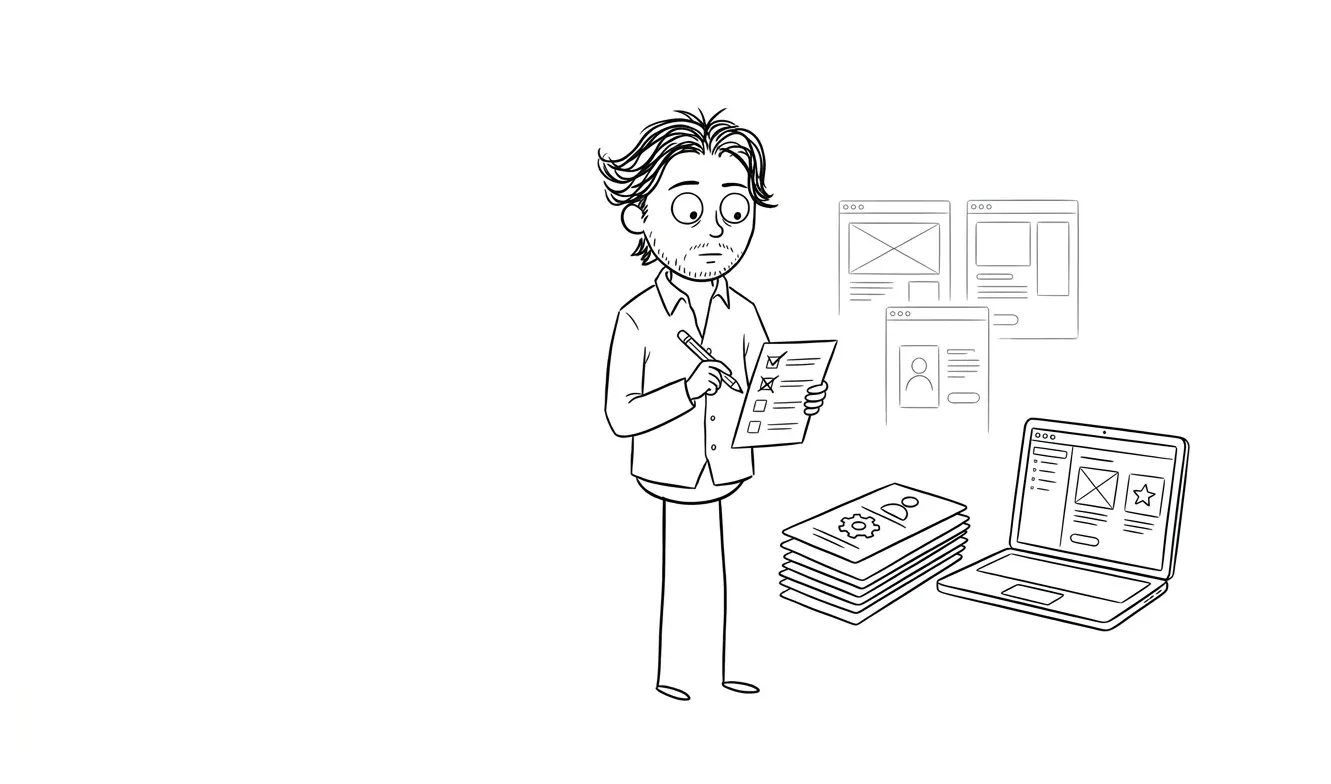
Fear. You’re scared the MVP won’t be good enough, so you add features to feel safer. This is the most common cause.
Stakeholder pressure. Someone with authority (a co-founder, an investor, an advisor) says “we definitely need X,” and you add it without challenging whether it helps test your core assumption.
Feature trading. You cut one feature and immediately replace it with another of similar complexity. The scope stays large even though you thought you were cutting.
The fix for all three is the same: keep the assumption written down somewhere visible, and make every feature justify its existence against that assumption. When someone says “we definitely need X,” the response is: “Does X help us test whether [assumption] is true? If not, let’s put it in the v2 list.”
A written scope document helps. Even a simple one. Decisions made verbally in a meeting get forgotten or misremembered. Decisions in writing can be referenced.
If you’re not sure where to start with that document, a focused audit and spec can help you figure out what you actually need before you commit to building anything.
How to scope an MVP without overbuilding when you’re technical
Technical founders have a specific version of this problem. They want to build the right architecture from day one. They add complexity to the backend because they’re thinking about scale, and scale doesn’t matter yet.
A few principles for technical founders in particular:
Build for the next 10 users, not the next 10,000. You’re not Instagram. Your architecture doesn’t need to handle Instagram-scale load right now.
Pick boring technology. The MVP phase is not the time to learn a new framework or experiment with an unfamiliar database. Use what you know best, ship fastest.
Don’t abstract too early. Abstraction and modularity make sense when you know the shape of the problem. You don’t know the shape yet. Build the simplest direct implementation first.
Monolith before microservices. Unless your team is already working at a scale where a monolith causes real coordination problems, start with a monolith. You can split it later.
The goal is the same as the non-technical version: ship something that tests the assumption, then learn from it.
This is sometimes called the Gall’s Law principle in systems design: every working complex system evolved from a working simple system. Starting complex is how you end up with a system that never quite works.
Using a landing page as part of your MVP scope
Sometimes the right MVP isn’t a product at all, at least not yet.
A landing page with a clear value proposition and a signup button can tell you whether there’s demand before you build anything. If nobody signs up, or nobody clicks the CTA, that’s data. You’ve learned something important at a fraction of the cost of building a full product.
This works best when your riskiest assumption is about demand. “Will people want this?” is a question a landing page can help answer. “Will people actually use this in their workflow?” is a question that requires a working product.
If your core assumption is about demand, consider starting with a landing page. I write more about what makes one actually convert in what makes a landing page convert, which is worth reading before you commit to any copy or structure.
If you do need to move fast from landing page to working product, the Idea to MVP service covers both ends of that process.
What good MVP scope looks like in practice
Here’s a rough framework for evaluating your scope before you commit to building.
| Scope element | Good sign | Red flag |
|---|---|---|
| Number of core user flows | 1-3 | More than five |
| Time to build | 4-8 weeks | More than 12 weeks |
| Features in v1 | Only what tests the assumption | Everything you eventually want |
| Backend complexity | Simple, maybe manual | Custom infrastructure built for scale |
| User types | One | Multiple roles before product is validated |
| Success metric defined? | Yes, specific and measurable | Vague or absent |
If your scope hits multiple red flags, keep cutting.
How to prioritize what survives the cut
Cutting features is one thing. Deciding which ones make it through is another. When you’re down to a list that feels genuinely hard to cut further, a simple prioritization pass helps.

For each remaining feature, ask two questions:
- How directly does this help test the assumption? (High, medium, or low)
- How long does it take to build? (Days vs.weeks)
Anything that’s high-impact and fast to build stays. Anything that’s low-impact and slow to build goes. The hard calls are the high-impact things that are also slow to build. That’s where you look for the shortcut, the manual version, the fake backend, or the third-party tool that gets you 80% of the way there in a fraction of the time.
This is also where a second set of eyes helps. When you’re close to a product idea, it’s almost impossible to see which features are load-bearing and which ones just feel that way. A short scoping conversation or a focused product audit often surfaces shortcuts you can’t see from inside the idea.
Need help scoping your MVP? I offer a flat-fee Idea to MVP service that takes you from concept to shipped product. If you want a focused look at scope and spec before committing to a full build, the $500 audit covers exactly that. Tell me about your project.
When to stop cutting
There’s a version of this advice that goes too far. You can scope yourself into something that doesn’t work at all, doesn’t feel complete enough to get meaningful feedback, or doesn’t respect the user enough to be worth their time.
The line is in the word “viable.” If a user can’t complete the core task your product is supposed to help with, the MVP isn’t viable. You need to build enough that the core flow actually works.
The question to ask: can a real user, with no help from you, accomplish the main thing your product is supposed to help them accomplish? If yes, that’s your floor. Everything else can wait.
Frequently asked questions
How do I know what features to include in an MVP?
Start with your riskiest assumption, and only include features that directly help you test it. If a feature doesn’t help prove or disprove your core hypothesis, it goes in the v2 list. Most MVPs should have one to three core user flows, nothing more.
How long should it take to build an MVP?
A well-scoped MVP should take four to eight weeks to build. If your timeline is stretching past 12 weeks, the scope is almost certainly too large. Anything longer than that, and you’re likely building features that don’t belong in the first version.
What’s the difference between an MVP and a prototype?
A prototype is something you use to test a design or idea, usually with no real functionality. An MVP is a working product that real users can use to accomplish a real task. Both are useful, but they answer different questions at different stages.
Can a landing page count as an MVP?
Yes, in specific cases. If your riskiest assumption is about demand, a landing page with a clear value proposition and a signup or waitlist CTA can validate that before you build anything. If your assumption is about whether users will actually use the product, you need a working product.
What are the most common things that don’t belong in an MVP?
Admin panels, notification systems, settings and preferences, user roles and permissions, analytics dashboards, and social features are almost never essential to an MVP. They feel important but they don’t help you test your core assumption faster.
How is the dee.agency MVP service different from hiring a development agency?
It’s one person doing design and code together, with no agency overhead, at a flat fee of $9,000. The process is focused on scoping down to what matters and shipping fast, not expanding scope to fill a retainer. You can read more on the Idea to MVP page.
Ready to scope and ship your MVP?
If you’re going in circles on what to build, a focused conversation is usually the fastest way through it. The Audit + Spec service is a $500 focused engagement that looks at one specific question, including scope and what to build first, and the fee credits toward a full build if you move forward within 30 days.
Or if you’re ready to build, reach out and tell me about your project.

Got a project worth shipping? Send the brief.
Quote and kickoff date back in a day, usually faster. If it's not a good fit I'll say so.