

Audit Decision Brief Template: From Finding to Action
Use this audit decision brief template to turn focused findings into an approved next step with evidence, scope, risks, and acceptance criteria.
An audit decision brief turns a focused finding into a decision someone can approve, reject, test, or defer. It connects the evidence to one bounded recommendation, names what is inside and outside scope, records dependencies and risks, and defines how completion will be reviewed. Use the audit decision brief template below after findings have been prioritized but before implementation begins.
Dee Agency’s $500 Audit + Spec examines one focused lens at a time rather than the whole business. The fee is credited 100% toward follow-on work booked within 30 days. A decision brief preserves that boundary while making the next action clear enough to assign and review.
What is an audit decision brief?
An audit decision brief is a short document that frames one decision arising from an audit. It is narrower than an audit report and more complete than a backlog ticket. The report explains what was examined and what was found; the brief asks an accountable person to choose a specific next step.
A useful brief answers these questions:
- What decision needs to be made?
- What evidence from the audit supports it?
- Which user journey, workflow, page, or system is affected?
- What options are available?
- What does the audit recommend, and why?
- What remains outside this decision?
- What dependencies and risks could change the plan?
- How will the team know the approved work is complete?
The brief should preserve uncertainty. If the evidence supports a test rather than a full implementation, the recommended decision should be to run that test. A polished document should not make a hypothesis sound proven.
When should you use an audit decision brief?
Use a decision brief when a finding requires agreement before work can proceed. It is especially useful when several roles must align on the problem, the proposed response, or the boundary of implementation.
Common situations include:
- A landing page uses conflicting offer language and needs one approved message hierarchy.
- An AI-assisted workflow lacks a validation step, but the owner and fallback process are unresolved.
- A service page sends inconsistent entity or canonical signals and needs a bounded visibility fix.
- An MVP flow exposes an error state that requires a product decision before design or development.
- A broader redesign has been proposed, but the evidence currently supports only a smaller correction or test.
Not every finding needs its own brief. Clear, low-risk corrections can move directly into a specification when authority, scope, and acceptance criteria are already settled. Use a brief where an unresolved decision would otherwise cause rework or quiet scope expansion.
Before writing one, rank the findings. The audit prioritization matrix separates evidence, impact, effort, risk, dependencies, and learning value so the team does not create detailed briefs for every observation.
What belongs in an audit decision brief?
A practical audit decision brief has 12 parts. Keep each part short enough to review in one sitting, but specific enough that another person can understand the reasoning without reconstructing the audit.
1. Decision statement
Write the decision as a question with an accountable outcome.
Weak: “Improve the landing page.”
Better: “Should the landing page adopt one approved offer name across the hero, pricing section, form, metadata, and confirmation state before the next campaign?”
The better version identifies the surface, the consistency problem, and the decision boundary. It does not promise a conversion result the evidence cannot support.
2. Audit lens and scope boundary
Name the focused lens that produced the finding. Examples include offer clarity, checkout friction, AI-output validation, accessibility, or AI visibility.
Then state what the audit did not examine. A focused landing-page message review may not cover acquisition strategy, brand positioning across every channel, technical performance, or the whole product experience. Naming exclusions prevents a bounded recommendation from being mistaken for a complete business diagnosis.
3. Finding
Describe the observed problem before proposing a solution. A finding should be inspectable and written without loaded language.
For example:
The hero calls the offer a strategy session, the pricing section calls it a consultation, and the form asks users to apply for an assessment.
That statement is stronger than “the copy is bad.” It records the inconsistency another reviewer can verify.
4. Evidence
List the evidence that supports the finding and label its strength. Useful evidence can include screenshots, page content, reproducible behavior, workflow records, analytics tied to the exact question, user research, support themes, or documented system states.
Use simple labels:
- Observed: directly visible or reproducible
- Supported: several relevant signals point to the same issue
- Hypothesis: plausible, but more evidence is needed
Do not convert a hypothesis into a fact because implementation feels urgent. If the evidence is weak, the next step may be instrumentation, a prototype, or a controlled test.
5. Affected journey or workflow
Identify where the problem occurs. Name the entry point, affected step, expected action, and downstream consequence within the audit lens.
Concrete scope descriptions are better than invented percentages. Write “the primary inquiry form and its confirmation state,” not “most leads.” Write “every automation output written to the CRM,” not an unsupported failure rate.
6. Constraints
Record conditions the decision must respect. These may include approved pricing, existing technology, accessibility requirements, data handling, available content, integration permissions, legal review, a launch dependency, or a manual fallback that must remain available.
Constraints are not excuses. They describe the design space so reviewers can compare realistic options.
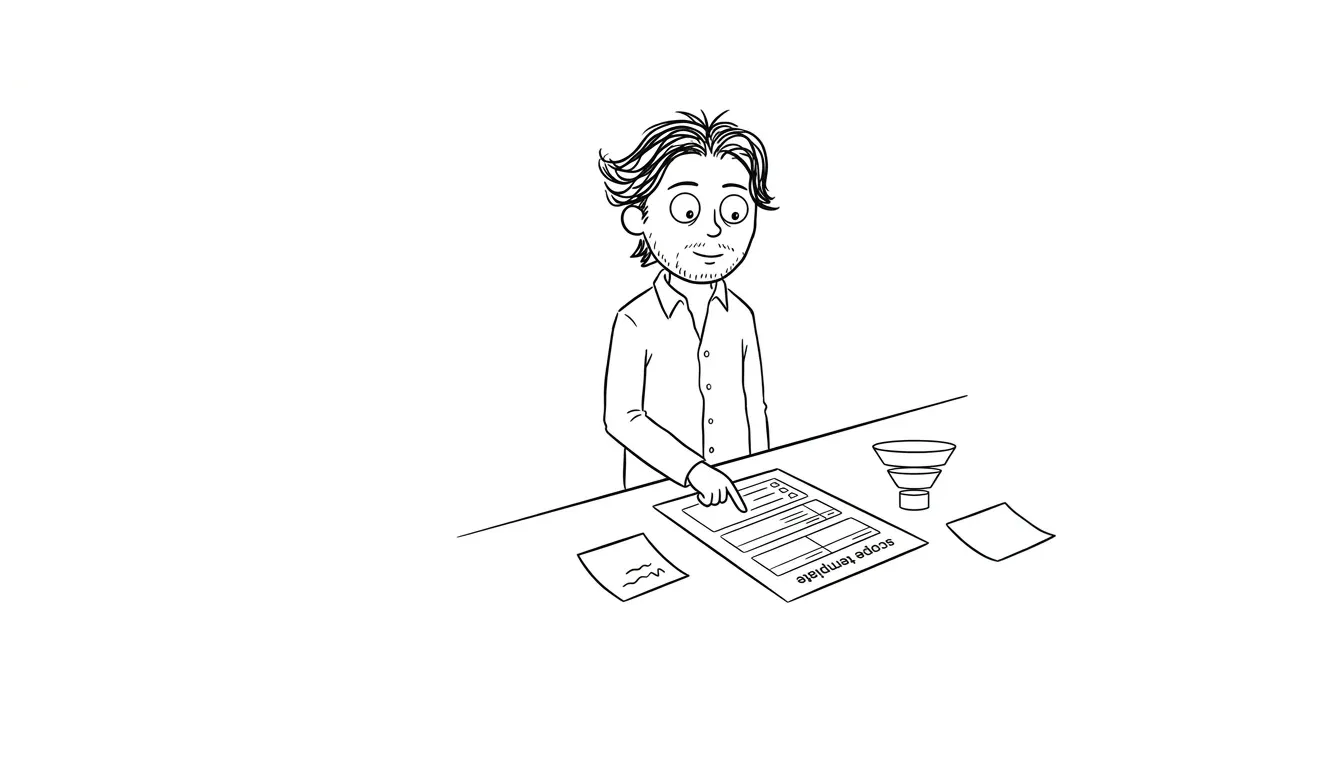
7. Options considered
Include at least two credible options when a real choice exists. One option can be to defer or gather more evidence.
For each option, capture:
- What changes
- What remains unchanged
- Which evidence it addresses
- Key dependencies
- Main risk
- Reversibility
Avoid padding the list with obviously bad alternatives just to make the recommendation look stronger. The purpose is to show the actual tradeoff.
8. Recommendation and rationale
State the recommended option in one paragraph. Tie the rationale to the audit evidence and constraints rather than preference.
A useful rationale might say that aligning five visible offer labels is recommended because the inconsistency is directly observable, affects the primary inquiry path, has an approved source of truth, and can be corrected without changing the underlying service. It should not claim the correction will produce a specific revenue or conversion lift.
9. Scope and exclusions
List exactly what implementation includes. Then list adjacent work that remains excluded.
For a message-consistency correction, scope might include the hero, CTA labels, pricing heading, form introduction, confirmation copy, title, description, and structured data. Exclusions might include a new brand strategy, traffic acquisition, a full visual redesign, or changes to other services.
This section is one of the best defenses against scope creep. If new information justifies broader work, create a separate decision rather than silently expanding the approved one.
10. Acceptance criteria
Acceptance criteria define observable completion. They should verify the change, not guarantee a market outcome.
Good criteria include:
- One approved offer name appears on every listed surface.
- The primary CTA uses one consistent action label.
- Form and confirmation copy describe the same next step.
- Metadata and structured data use the approved service name.
- Desktop and mobile review show no conflicting legacy labels.
“Conversion improves” is not a completion criterion unless a separate experiment defines the measurement method, threshold, duration, and decision rule.
11. Dependencies, risks, and rollback
Name what must happen before work starts, what could fail during implementation, and how the change can be reversed or mitigated.
A content correction may depend on final service language. An automation change may depend on system access, test data, an owner for exceptions, and a manual fallback. An AI visibility correction may require canonical, schema, sitemap, and crawler settings to agree.
Keep risks concrete. Do not invent incidents. Describe the failure mode supported by the actual workflow, such as conflicting records, an inaccessible state, a broken form submission, or contradictory crawl signals.
12. Owner and review point
Assign one owner for the decision and one owner for implementation when those roles differ. Record who reviews acceptance criteria and what evidence closes the item.
Also define a review point for decisions that remain uncertain. That may be after a test, after a dependency is resolved, or after enough live activity has been observed to evaluate the next step. Use conditions rather than arbitrary urgency where possible.
Copyable audit decision brief template
Copy this structure into a document, issue, or project workspace:
# Audit decision brief: [short decision name]

## Decision requested
[Write the decision as a question that can be approved, rejected, tested, or deferred.]

## Focused audit lens
Lens: [the one question or area examined]
In scope: [surfaces, journey, workflow, or system]
Outside scope: [adjacent areas not examined]

## Finding
[Describe the observed problem without prescribing the solution.]

## Evidence
- [Evidence item] — Observed / Supported / Hypothesis
- [Evidence item] — Observed / Supported / Hypothesis

## Affected journey or workflow
Entry point:
Affected step:
Expected action:
Consequence within the audit lens:

## Constraints
- [Approved source of truth, platform, access, policy, content, or fallback]

## Options considered
### Option A: [name]
Change:
Dependencies:
Risk and reversibility:

### Option B: [name]
Change:
Dependencies:
Risk and reversibility:

### Option C: Defer or gather evidence
Evidence needed:
Reconsider when:

## Recommendation
[Name the option and explain why the evidence and constraints support it.]

## Implementation scope
Included:
- [item]

Excluded:
- [item]

## Acceptance criteria
- [observable completion condition]

## Dependencies
- [decision, input, access, or preceding work]

## Risks and rollback
Risk:
Mitigation:
Rollback or fallback:

## Ownership and review
Decision owner:
Implementation owner:
Reviewer:
Review evidence:
Revisit condition:
Keep links to screenshots, tests, or source records beside the relevant evidence. The brief should point to the audit report rather than duplicate every observation from it.
How do you turn the brief into an implementation spec?
Once the decision is approved, convert only the selected option into implementation work. The spec should inherit the brief’s scope, exclusions, constraints, dependencies, and acceptance criteria.
A clean handoff follows this sequence:
- Approve, reject, test, or defer the decision.
- Confirm dependencies and owners.
- Translate the approved scope into tasks or states.
- Preserve exclusions in the implementation ticket.
- Review the work against acceptance criteria.
- Record any new evidence that changes the original decision.
The focused audit deliverables checklist shows how findings, recommendations, and specifications should connect. The focused audit scope template helps define the lens before evidence is gathered.

If implementation reveals a different problem, pause and update the decision record. Do not use the original approval as permission for unrelated work.
Common audit decision brief mistakes
Avoid these patterns:
- Starting with a preferred solution. Document the finding and evidence first.
- Leaving the decision implicit. Reviewers should know exactly what they are approving.
- Omitting the audit lens. Without it, a focused finding can be mistaken for a whole-business conclusion.
- Listing evidence without its strength. Observations and hypotheses should not carry the same confidence.
- Using unsupported outcomes. Do not invent revenue, conversion, accuracy, or time-saving claims.
- Hiding dependencies. Access, ownership, source content, and policy decisions can determine sequence.
- Treating acceptance criteria as goals. Completion criteria verify the implementation; they do not guarantee impact.
- Skipping exclusions. Adjacent work will otherwise enter scope through review comments and follow-up requests.
- Creating a brief for every minor issue. Reserve it for decisions that need alignment or authority.
- Never closing the loop. Record the decision, owner, and review evidence.
How long should an audit decision brief be?
A decision brief should be as short as the decision allows. A bounded content correction may fit on one page. A higher-risk workflow or integration change may need more detail on states, permissions, failure modes, and rollback.
Length is not the quality measure. A useful brief makes the reasoning inspectable. If reviewers cannot identify the decision, evidence, scope, tradeoff, and completion condition, adding more background will not fix the structure.
What if stakeholders disagree with the recommendation?
Return to the decision criteria rather than arguing from authority or preference. Ask which evidence is disputed, which constraint is missing, or which risk has been weighted differently.
The disagreement may lead to one of four productive outcomes:
- Correct the finding because the evidence was incomplete.
- Add a missing option.
- Gather evidence before implementation.
- Record that the decision owner accepts a specific tradeoff.
A decision brief does not remove judgment. It makes judgment visible and keeps the implementation tied to an explicit choice.
Make the next action reviewable
The audit decision brief template works when someone outside the original review can see what was found, why it matters within one focused lens, what options were considered, and what completion means. Keep evidence and uncertainty visible, preserve the scope boundary, and turn only the approved recommendation into implementation work.
Dee Agency’s $500 Audit + Spec produces a focused diagnosis and a bounded specification, with the fee credited 100% toward follow-on work booked within 30 days. Review the service menu, or share the specific decision that needs clarity to start with one focused lens.

Got a project worth shipping? Send the brief.
Quote and kickoff date back in a day, usually faster. If it's not a good fit I'll say so.