

MVP Pricing Page Checklist Before Someone Books
A practical MVP pricing page checklist covering price, scope, timeline, deliverables, exclusions, and proof. Built for founders and service businesses.
A good MVP pricing page tells visitors exactly what they’re getting, what it costs, and what’s not included, all before they have to ask. This checklist covers the seven elements every MVP pricing page needs: a clear price, scope definition, timeline, deliverables list, exclusions, proof, and a single CTA. If you’re a founder or small service business creating an MVP pricing page, use this to audit what you have or build from scratch.
Why your MVP pricing page checklist starts with clarity, not persuasion
Most founders treat pricing pages like sales copy. That’s backwards.
The people looking at your pricing page have already decided they’re interested. What they need now is enough information to make a decision. Confusion at this stage doesn’t create mystery. It creates silence. They close the tab.
A pricing page that converts does one thing well: it removes doubt. That means being specific about price, scope, timeline, and what happens when someone says yes.
Clear pricing pages don’t lose deals. Vague ones do.
Before you add another testimonial carousel or animated gradient, run through this checklist. Every item here has a job to do.
What counts as an MVP pricing page?
If you’re selling a service that helps founders build a product, your pricing page is a client acquisition tool. If you’re a founder with a product, your pricing page is a conversion tool. The checklist applies to both.
The items below are built around a service-business framing, specifically for studios and consultants selling MVP design or development. But founders with early products will find most of it directly applicable, especially the scope, timeline, and exclusions sections.
For the product side, Stripe has solid pricing page design guidelines worth reading alongside this.
The MVP pricing page checklist
Work through each item. If you can’t check it off, that’s what to fix next.

1. Price is visible without scrolling
This sounds obvious. Plenty of pages still hide it.
Your price should appear above the fold, or within the first scroll. “Starting from” is acceptable if you have a genuine range. “Contact us for pricing” on an MVP service page is a conversion killer unless you’re specifically targeting enterprise clients who expect that.
Visitors use price to qualify themselves. Let them.
- Price (or clear starting price) is visible in the hero or first section
- Price is formatted unambiguously: dollar amount, not “investment starting at mid-four-figures”
- If you have multiple tiers, each tier has its price clearly labeled
2. Scope is defined in plain language
“Full MVP” means nothing. “We build your product” means nothing. Scope needs to be specific enough that a non-technical founder understands exactly what they’re buying.
For a service like Idea to MVP, the scope definition needs to answer: what type of product, how many core flows, which platform, what the handoff looks like.
- Scope explains what type of work is included (design, development, or both)
- Number of screens, flows, or features is specified or clearly defined by process
- Platform is stated: web, mobile, or both
- What “done” looks like is described in concrete terms
3. Timeline is stated explicitly
“We work fast” is not a timeline. Founders planning a launch need to know if the work takes two weeks or two months.
If your timeline varies, show a range and explain what affects it. The most common timeline driver is how quickly the client provides input. Say that.
- A specific timeline is stated (for example, “6-8 weeks from kickoff”)
- Timeline dependencies are disclosed (for example, “contingent on client feedback within 48 hours”)
- Kickoff-to-delivery sequence is described, even briefly
4. Deliverables are listed specifically
Don’t say “everything you need to launch.” Say what they actually get.
Deliverables should be concrete enough that a client knows what files they’ll receive, what accounts they’ll own, and what they can hand to someone else later.
- List of deliverables is explicit (for example, Figma source files, deployed codebase, documentation)
- File ownership and access is addressed
- If there’s a handoff call or walkthrough, it’s mentioned
5. Exclusions are stated clearly
This is the section most pricing pages skip. It’s also the one that prevents the most scope disputes.
If you don’t do copywriting, say that. If payment integration isn’t included in the base price, say that. If hosting and domain setup are the client’s responsibility, say that.
Exclusions aren’t a warning label. They’re a trust signal. They show you’ve done this before and know where confusion happens.
Clients who read a clear exclusions section don’t feel tricked later. Clients who don’t have one often do.
- Explicitly lists what’s not included in the quoted price
- States who handles copywriting, photography, or content
- Clarifies whether third-party tools, APIs, or subscriptions are included
- Addresses hosting, domains, and ongoing maintenance
6. Process is summarized in steps
A pricing page without a process summary asks the client to take a leap of faith. A brief “here’s what happens next” section answers the most common question: what actually happens after I pay?
Four to six steps is enough. You’re not writing a project management guide. You’re removing the fear of the unknown.
- Process summary includes the first step after purchase or inquiry
- Client touchpoints are described (kickoff call, check-ins, review rounds)
- Revision policy or feedback windows are mentioned
- What the client needs to provide is listed (brief, existing assets, logins, etc.)
7. Proof that doesn’t require fake logos or inflated numbers
Testimonials help. But if you’re early and don’t have them, you have other options.
You can describe the types of problems you’ve solved, share relevant background (specific industry experience, for example), or link to case studies. What you shouldn’t do is pad the page with logos you don’t have permission to use or generic five-star ratings with no context.
Real proof is specific. “Worked with 200 clients” without any supporting specifics is just a number. A brief case study that explains a problem and outcome is more credible than a wall of unattributed logos.
- At least one form of social proof is present (testimonial, case study, or relevant credential)
- Proof is specific, not generic
- Any logos used are ones you have permission to display
- Case studies link to more detail where possible
For context on what good case study pages look like, Basecamp’s Shape Up documentation is a useful reference for how to frame product decisions in writing.
8. One clear CTA
Every pricing page needs one primary action. Not three. Not a newsletter signup and a demo booking and a contact form.
Pick one: book a call, fill out a form, or send a message. Everything else is a distraction.
- One primary CTA is dominant on the page
- CTA appears at least twice (top and bottom of page)
- CTA button copy is specific (“Start your MVP project”) not generic (“Get started”)
- Clicking the CTA leads somewhere, not a dead email address or broken form
Should you audit before you build?
If you’re not sure what to put in the scope section of your pricing page, that’s a sign you haven’t fully defined what you’re selling yet. A focused Audit + Spec can help you get there.
The Audit + Spec is a $500 single-lens review. You pick the focus: pricing page, product scope, onboarding flow, whatever needs the most clarity. The output is a clear spec you can act on. If you move to a full build within 30 days, the $500 is credited toward the project.
It’s a useful step if you’re trying to scope an MVP service page before committing to a full build. Related reading on scoping: how to scope an MVP without overbuilding.
Need help scoping your MVP service or product? Dee Agency offers a flat-fee Audit + Spec for exactly this situation. Start the project conversation.
Common MVP pricing page mistakes
These show up constantly, and each one costs conversions.
Hiding the price behind a sales call
This works for enterprise software where pricing is genuinely custom. For a $9,000 fixed-fee MVP build, requiring a call before disclosing price filters out exactly the founders who have done their research. They leave.
Listing features instead of outcomes
“12 screens, 3 user flows” is fine as a scope detail. It shouldn’t be the headline. What the founder actually wants to know is: will I have something I can show investors and users at the end of this? Lead with the outcome, then back it up with scope.
Scope language that creates expectations you can’t meet
“Fully functional app” is a promise you’ll have to define differently for every client. Use precise language. “A web app covering your two core user flows, built in React, deployable to Vercel, with a Figma file included” is something you can deliver and verify.
No answer to “what if I need more?”
Clients wonder what happens if the scope grows. Address it. A short “additional work is scoped separately” or “changes beyond two revision rounds are billed at X” gives them context without turning the page into a legal document.
Treating the pricing page as the last step
Your pricing page should link to next steps, a brief, or a contact form. It shouldn’t be a dead end. Founders who want to move forward need a frictionless path to doing that.
For more on common product missteps, the article on common UX mistakes in SaaS products covers related ground.
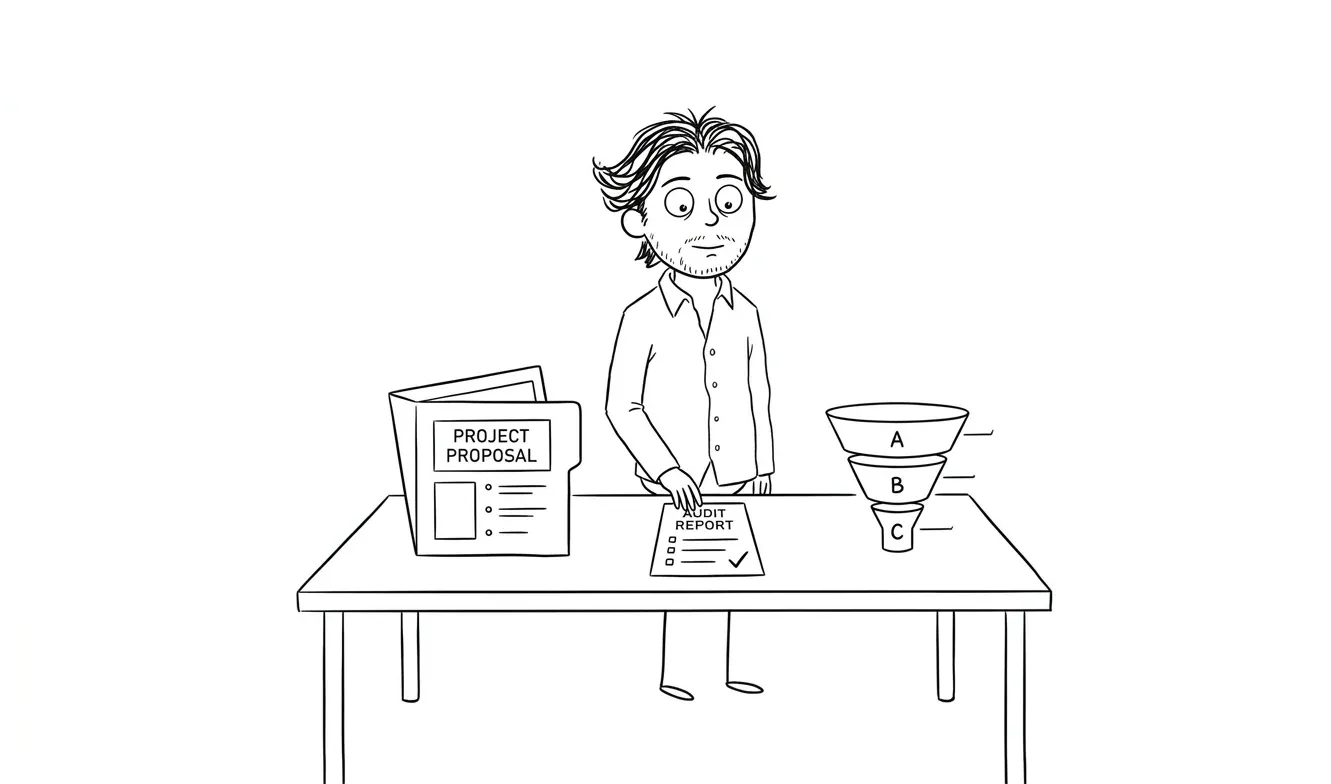
When to use a $500 audit before a $9,000 build
If any of the following are true, start with an Audit + Spec before going into a full Idea to MVP build:
- You’re not sure what scope to promise on your pricing page
- You have a vague product concept but haven’t validated the core flow
- You’ve built something and conversion is low but you don’t know why
- You want a clear spec document before committing to build costs
The Audit + Spec gives you a single-lens analysis and a specific set of recommendations. It’s $500 and credits toward follow-on work within 30 days. It’s a low-risk way to get clarity before committing to a larger project.
More on what the validation process looks like: MVP validation plan: what to prove before you build.
Frequently asked questions
What should an MVP pricing page always include?
At minimum: a visible price, a defined scope, a timeline, a deliverables list, exclusions, and a single clear CTA. Missing any of these creates doubt, and doubt kills conversions. A process summary and at least one piece of social proof round it out.
How specific should scope language be on an MVP pricing page?
Specific enough that a non-technical founder understands what they’re buying without a phone call. Name the platform, the number of flows or screens, what files they receive, and what “done” looks like. Vague scope language leads to scope disputes later.
Should I list exclusions on my pricing page?
Yes. Exclusions are a trust signal, not a disclaimer. Listing what’s not included (copywriting, hosting setup, third-party API costs) prevents mismatched expectations and shows you’ve done this before.
When does it make sense to do an audit before building an MVP?
When you haven’t defined your core flow, when your pricing page is underperforming and you don’t know why, or when you want a clear spec before committing to build costs. A focused Audit + Spec at $500 is designed for exactly that situation and credits toward a follow-on build within 30 days.
How many CTAs should an MVP pricing page have?
One primary CTA. You can repeat it at the top and bottom of the page, but it should be the same action. Multiple competing CTAs split attention and reduce conversions.
What’s the difference between a pricing page and a landing page for an MVP service?
A landing page leads with the problem and builds toward the offer. A pricing page assumes the visitor is already considering and focuses on specifics: price, scope, process, and proof. Most service businesses need both. The landing page service at dee.agency handles the persuasion layer; the pricing page checklist above handles the conversion layer.
Ready to build or fix your MVP pricing page?
If your pricing page is losing potential clients, or you’re building one from scratch and want it right the first time, Dee Agency can help.
The Idea to MVP service covers design and build from concept to deployed product at a flat fee of $9,000. If you want to start smaller and get a clear spec first, the Audit + Spec is $500 and credited toward the build.
Start the project conversation and Dee Agency will help figure out the right starting point.

Got a project worth shipping? Send the brief.
Quote and kickoff date back in a day, usually faster. If it's not a good fit I'll say so.